Tuesday, December 10, 2019

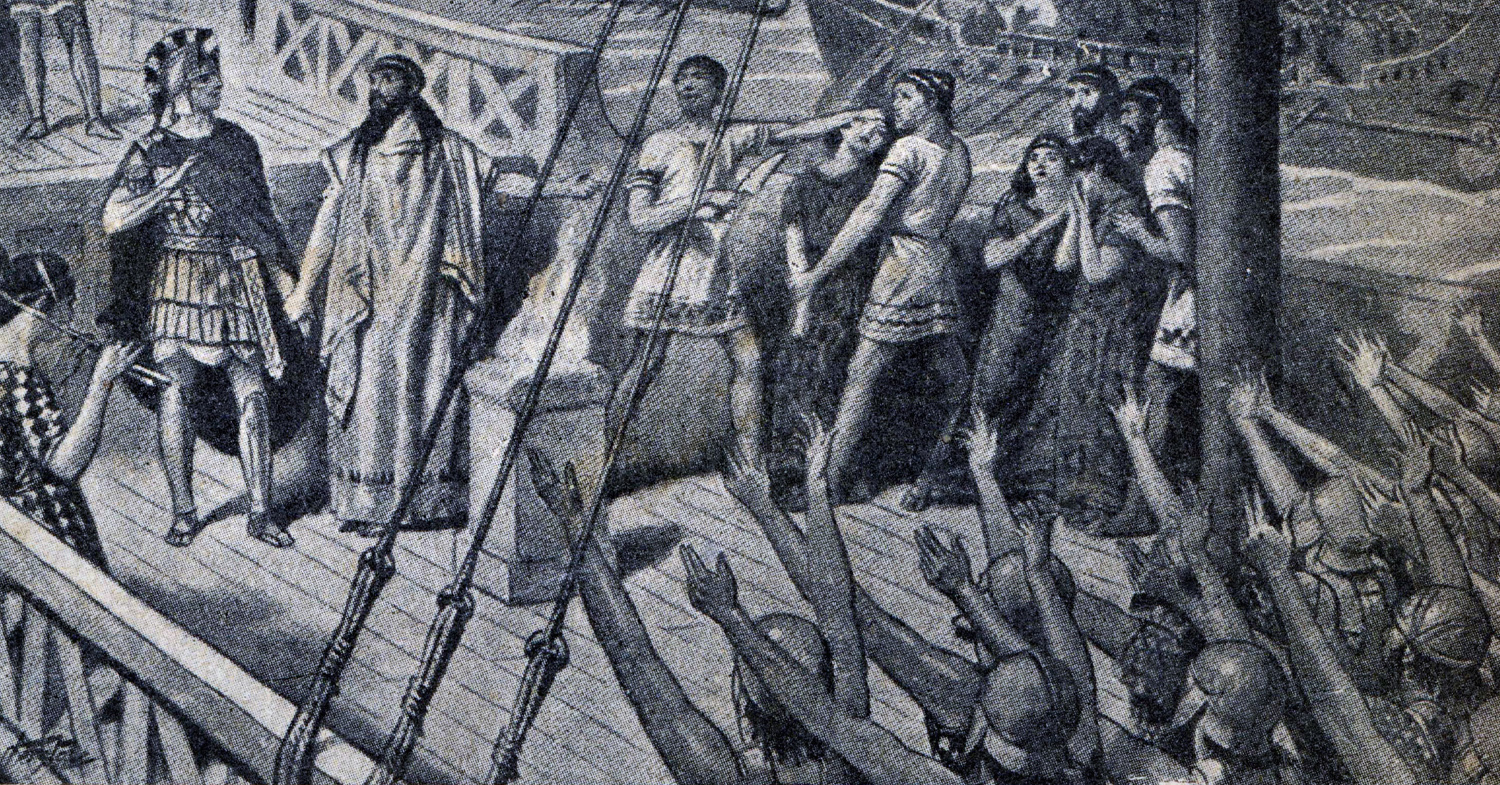
Themistocles Allegedly Conducted A Human Sacrifice Before The Battle of Salamis


Themistocles was an Athenian politician and military strategist who was pivotal in the Greek defeat of the Persian invasion of Greece by Xerxes in 480 BCE. Athens’ great naval strength was in large part due to Themistocles’ influence, as he pushed the Athenians to invest in sea power and to fight Persians in the Aegean. He was the mastermind of the Battle of Salamis, where the Greek coalition navy lured the massive Persian fleet into a narrow strait and delivered a shocking defeat upon Xerxes’ forces. As usually happens, the Greek victory was attributed to sound strategy, stout sailors, and divine aid. Yet, the latter divine component, according to some stories, was gained through unorthodox means. According to legend, Themistocles conducted a human sacrifice in order to cultivate the favor of the gods for his cause.

Plutarch (c. 50-120 CE), the great Greek-Roman biographer, preserved the tale about the human sacrifice of Themistocles in his famous work, the Parallel Lives. He attributed the tale to Phanias of Lesbos (flourished 300 BCE), whom Plutarch described as “a philosopher well read in history” (Life of Themistocles, 13.3).

As the story goes, Themistocles had been preparing an average, human-less, sacrifice in the runup to the Battle of Salamis. A certain prophetic man called Euphrantides, however, had something else in mind to catch the attention of the gods. Central to Euphrantides’ vision was a trio of Persian captives, who presumably came from the upper echelons of society, as they had been wearing elegant clothes and expensive jewelry at the time of their capture. Rumor suggested that the three prisoners were relatives of Xerxes, yet Plutarch admitted that their presumed royal rank was more speculation than proven fact.

When the three Persian prisoners were brought forward, Euphrantides reportedly began crying out for a human sacrifice. He pointed out omens that, according to him, suggested that the gods were eager for the sacrifice to take place. Such omens included the flames of the sacrificial fire rising visibly higher as the Persians neared the altar, and a sneeze—long considered a sign of divine favor or agreement—that rang out from the crowd as the human sacrifice was being discussed. Euphrantides’ mystical charisma, along with the omens that he pointed out, was evidently enough to convince the people to go along with his idea of a human sacrifice.

Themistocles reportedly had some reservations about the sacrifice, but as the people were on Euphrantides’ side, he let the sacrifice commence. Euphrantides was said to have directed the ceremony, but Themistocles or others present had the grisly job of carrying out the sacrifice. The proceedings were mainly catered toward the god Dionysus (or Bacchus), for the prophet claimed that particular deity would be easily swayed by the human sacrifices. Plutarch wrote:

“Themistocles was much disturbed at this strange and terrible prophecy, but the common people, who, in any difficult crisis and great exigency, ever look for relief rather to strange and extravagant than reasonable means, calling up Bacchus with one voice, led the captives to the altar, and compelled the execution of the sacrifice as the prophet had commanded” (Life of Themistocles, 13.3).

It has long been debated whether to categorize the idea of Ancient Greek human sacrifices as legendary or historical. Sporadic descriptions of ancient Greeks conducting human sacrifices can be found in Greek histories and lore, but little archeological evidence has been found to prove the stories true. In 2016, however, the skeleton of a possibly sacrificed ancient Greek individual was found buried at a shrine of Zeus on Mount Lykaion. The skeleton serves as a rare piece of evidence that may back up the legends of ancient Greek human sacrifice. Yet, even so, such sacrifices must have been fairly anomalous in the wider Greek practice of religion.

Written by C. Keith Hansley

Picture Attribution: (Illustration of Themistocles Performing a human sacrifice before the battle of Salamis, created c. 1915, [Public Domain] via Creative Commons).

Sources:
  • Plutarch’s Lives edited by Charles W. Eliot in the Harvard Classics series. New York: P. F. Collier & Son, 1909, 1937.
  • http://penelope.uchicago.edu/Thayer/E/Roman/Texts/Plutarch/Lives/Themistocles*.html 
  • https://www.britannica.com/biography/Themistocles 
  • https://www.britannica.com/event/Battle-of-Salamis 
  • https://www.britannica.com/biography/Xerxes-I  
  • https://www.britannica.com/biography/Phanias 
  • https://www.history.com/news/was-skeleton-unearthed-in-greece-a-human-sacrifice-to-zeus 
  • https://www.smithsonianmag.com/smart-news/did-ancient-greeks-engage-human-sacrifice-180960111/ 
  • https://www.livescience.com/55733-possible-human-sacrifice-to-zeus-discovered.html  

Monday, December 9, 2019

Halphas Or Malthus—A Demon Of Construction, Logistics, And Requisition


According to occultists and demonologists, Halphas (also known as Malthus) is a spirit who has powers quite unique from his supernatural comrades. Halphas appears in the Shemhaphorash of the Lemegeton (or the Lesser Key of Solomon), a peculiar renaissance-age text which purports to list seventy-two demons or spirits which, according to legend, were summoned and controlled by the biblical King Solomon. Halphus is the thirty-eighth spiritual being named in the text’s list, and is described as preferring to take the shape of a dove, but can transform into human form and speak with a hoarse voice. Unlike most of the other spiritual beings listed in the text, poor Halphas was said to have virtually no offensive capabilities in his demonic repertoire. Whereas his brethren could supposedly do such flashy things as smite cities, spread disease, and cause lightning storms and rogue waves, Halphas instead reportedly specializes in more mundane abilities.

As stated earlier, Halphas supposedly can transform into a dove, and this may be judged as one of his most stylish abilities. Using this form, Halphas can get a lay of the land and set the blueprints for his next talent—construction. Using either magic or supernatural knowledge, this demon knows how to build one hell of a tower. But wait, there’s more: Halphas’ job description says he will not only build the tower, but also do the requisition work to stock the new defensive feature with weaponry and ammunition. If that were not enough, this peculiar demon can also serve in the role of a recruiter and strategist, garrisoning the newly built tower with warriors and sending them where they need to go. So, instead of all the pieces being sold separately, Halphas apparently offers a bundled deal. For those who wish to read the original description of Halphas’ peculiar abilities in the original grimoire tone, the Lemegeton stated: “His Office is to build up Towers, and to furnish them with Ammunition and Weapons, and to send Men-of-War to places appointed” (Lemegeton, Shemhaphorash, #38).

Despite Halphas’ fairly undemonic and mundane abilities, his skills in architecture, requisition and logistics have apparently gained him an admirable following in the spiritual world. He supposedly rules over twenty-six legions of lesser spirits and is considered a nobleman with the rank of earl in the demonic hierarchy.

Written by C. Keith Hansley

Picture Attribution: (Sketch of a Gargoyle in Paris, by Charles Meryon c. 1853, [Public Domain] via Creative Commons).

Sources:
  • The Three Magical Books of Solomon by Crowley, Mathers and Conybear. Vega Publishing, 2019 (original publications c. 1888, 1898, 1904.
  • https://www.sacred-texts.com/grim/lks/lks05.htm#fr_20  

Sunday, December 8, 2019

The Comical Tale About The Ugly Feet Of Thórarin Nefjólfsson


A prominent Icelandic merchant named Thórarin Nefjólfsson happened to be in Túnsberg (now Tønsberg), Norway, at a time when King Olaf II Haraldsson (r. 1015-1028) was residing in the city. Thórarin reportedly was an intelligent, eloquent and candid individual. Yet, unfortunately for the Icelander, he was best known for another quality—ugliness. The Icelandic historian Snorri Sturluson (1179-1241) colorfully claimed, “Thórarin was exceedingly ugly, and particularly his limbs. He had big and misshapen hands, but his feet were uglier even by far” (Heimskringla, Saint Olaf’s Saga, chapter 85). Thórarin Nefjólfsson, for his part, embraced his own ugliness, and was the kind of person who enjoyed poking fun at his own features. Due to his endearing nature, his wealth, and his prominence, Thórarin was invited by King Olaf II to stay with the royal party for a time. The Icelander reportedly even had the honor of sleeping in the same hall as the king, along with other people that the monarch trusted.

As the story goes, one morning while King Olaf II was lying awake in his bed, not yet willing to get up, the king procrastinated by observing the bunks of the people around him, and in doing so, Olaf caught sight of something he thought to be truly grotesque. As the other occupants of the room began to stir, the king directed their attention to the horrific sight, and they all agreed it was one of the worst visual experiences they had ever witnessed. What had caught their attention, of course, was their Icelandic guest, specifically the sight of a single bare foot belonging to Thórarin Nefjolfsson that had popped out from the man’s bed covers during the night. According to Snorri Sturluson, King Olaf mused aloud to his comrades, “I have been awake for a while, and I have seen a sight which seems to me worth seeing, and that is, a man’s foot so ugly that I don’t think there is an uglier one here in this town” (Heimskringla, Saint Olaf’s Saga, chapter 85).

Thórarin Nefjolfsson soon woke up and realized that everyone in the hall was staring at his foot. King Olaf, with the boldness of a king, and the knowledge that Thórarin was a good sport about his appearance, spoke plainly to the Icelandic merchant and explained that they were all amazed by the ugliness of the man’s foot. Furthermore, according to Snorri Sturluson, King Olaf went on to proclaim, “I rather warrant you that there isn’t an equally ugly foot to be found, and I would even be willing to bet on that” (Heimskringla, Saint Olaf’s Saga, chapter 85). Hearing this assertion, Thórarin Nefjolfsson took the king up on his bet, and the two set their stakes for the wager. Thórarin Nefjolfsson, if he won, wanted to be officially invited into the king’s retinue, while Olaf’s request was for the Icelander to do a royal errand. With the bets set, Thórarin began planning how to find an uglier foot in the city of Túnsberg.

As the story goes, Thórarin Nefjólfsson did not have to look far for his answer. He did not have to leave the hall, nor even his bunk, for the winning exhibit. With a triumphant flourish, Thórarin popped out his other foot from under the bed covers and displayed it for all to see. His second foot was just as ugly as the first, yet the big toe on this newer foot had been amputated for some reason or other, causing it to be all the more ghastly.

Olaf II was on the verge of losing his bet, and everybody knew it, so the king had to think up a witty response to bring the wager back into his favor. After assessing the Icelander’s second foot, the king proclaimed that the amputated toe was a mercy, as there was one less horrendous digit to look at. According to Snorri Sturluson, the king further explained his reasoning by saying “The first foot is uglier because there are five toes on it, whilst this one has only four” (Heimskringla, Saint Olaf’s Saga, chapter 85). Thórarin Nefjólfsson did not dispute Olaf’s math and conceded victory to the king. Ultimately, however, both participants in the bet received what they wanted. The Icelander was named a member of King Olaf’s retinue, and Thórarin Nefjólsson completed an errand for the king by transporting an exiled Norwegian to Iceland.

Written by C. Keith Hansley.

Picture Attribution: (Scene of Thorarin Nefjolfsson and King Olaf II illustrated by Christian Krohg (1852–1925), [Public Domain] via Creative Commons).

Sources:
  • Heimskringla, by Snorri Sturluson and translated by Lee Hollander. Austin: University of Texas Press, 1964, 2018.

Thursday, December 5, 2019

The Dramatic Exile And Return of Bishop Aetherius Of Lisieux


Aetherius was a bishop of Lisieux, in northern France, during the reign of King Chilperic of the Franks (r. 561-584). The bishop was described as an incredibly forgiving man—the type who would overlook faults in the people he worked with and view them in the best possible light. Taking advantage of this kindness, people of ill-repute were able to work their way into the bishop’s inner circle with relative ease.  Consequently, Bishop Aetherius’ freely-given forgiveness, and the blind faith he placed in individuals, would inevitably come back to bite him. In spite of Bishop Aetherius’ hospitality, a group of bad actors who were given shelter in Lisieux eventually turned on their bishop, bringing chaos and scandal to the bishopric.  

Among those given a second chance by Bishop Aetherius in Lisieux was a certain priest from Le Mans. Tales about this disreputable priest were preserved by a contemporary bishop and historian named Gregory of Tours (c. 539-594), who wrote: “There lived in the town of Le Mans a certain priest, who was fond of fine living and who was always having affairs with women, a gluttonous man, much given to fornication and other forms of immorality” (History of the Franks, VI.36). This irreligious priest came into contact with Bishop Aetherius of Lisieux after a bizarre and scandalous episode. As the story goes, the priest of Le Mans took a concubine from a prominent family and dressed her in the garb of a monk so that they could be together. The concubine’s family was not at all pleased and they put great effort into tracking her down. After they found her with the priest, the angry family decided to detain them both.

The concubine’s family was not forgiving of their kinswoman’s behavior. According to Gregory of Tours, the family made the horrendous decision to burn the woman alive. The priest of Le Mans, too, was reportedly on the doorstep of death. Yet, before the family carried out the execution, they reportedly sent out word to the nearby bishoprics, giving the clergy a chance to ransom the life of their wayward clergyman. This offer of ransom made its way to forgiving, unjudging Bishop Aetherius who, according to Gregory of Tours, “paid over twenty pieces of gold to save the priest from immediate execution” (History of the Franks, VI.36). Once the scandalized priest from Le Mans was transported to Lisieux, Bishop Aetherius gave the man a job as a local instructor in the art of writing. Unfortunately for the community, the priest did not use his new lease of life to change his ways.

As Lisieux’s newest writing instructor, the priest from Le Mans was exposed to the local population. The youths of the region filled his classrooms and, of special interest to the priest, the youthful mothers of the students often came to check on how their children were progressing in their lessons. According to Gregory of Tours, “He [the priest] came to forget his earlier misdeeds, and, like a dog which had returned to its vomit, he made advances to the mother of one of the boys; but he had chosen a virtuous woman, and she told her husband what he was up to” (History of the Franks, VI.36). The failed advance of the priest reportedly resulted in the rallying of an armed band made up of the fathers of the priest’s students. These fathers and husbands marched en-masse against the priest from Le Mans and, once again, the wayward clergyman was said to have been on the doorstep of death. Yet, just as the mob of angry husbands was about to kill the lecherous priest, Bishop Aetherius reportedly swooped in at the last moment to save the man’s life for a second time.

Despite the bishop’s repeated mercy, the priest of Le Mans was said to have joined a faction that wished to oust and replace Bishop Aetherius. As the story goes, the plotters first considered assassination, but none of the members of the conspiracy could bring themselves to strike down the ever-trusting bishop. One of the plotters felt so guilty at the thought of attacking saintly Aetherius that he abandoned the conspiracy and confessed to the bishop. As no one was willing to murder their target, the conspirators decided to reach their goal through a different method. In the end, they chose to accuse Aetherius of a sin that was very well known by the priest of Le Mans. As the story goes, the conspirators launched a smear campaign against the bishop, alleging that women of ill repute had been seen coming and going from Aetherius’ quarters. Gregory of Tours colorfully disregarded these accusations, saying “Only the Devil could have put into their heads this idea of bringing such a charge against the Bishop, for he was nearly seventy years old!” (History of the Franks, VI.36).

After launching their smear campaign, the conspirators arrested Bishop Aetherius in an ecclesiastical coup. The conspirators placed the bishop in a cell while they tried to win over the local and monarchal authorities to their side. Aetherius, however, could not be contained in the cell for long. Through divine intervention or help from the bishop’s many sympathizers in the region, Aetherius was able to escape from captivity and escape from King Chilperic’s domain, instead seeking shelter in the realm of Chilperic’s brother, King Guntram (r. 561-593).

While Bishop Aetherius thrived in exile, making friends in Guntram’s court and being hosted by various bishops, the conspirators back in Lisieux were struggling to win the public to their side. Representatives from the coup against Bishop Aetherius reportedly went to King Chilperic to plead their case. The king, however, dismissed their accusations and ejected the conspirators from his court. Like King Chilperic, the people of Lisieux were skeptical of the accusations lodged against Bishop Aetherius. As the story goes, the people eventually rioted and attacked the members of the conspiracy. Once the congregation had wrested control of the bishopric back from the conspirators, they sent word to King Chilperic and asked him to restore Bishop Aetherius to power. Chilperic, who had no qualms with the exiled clergyman, sent word to his brother, King Guntram, asking for Aetherius to be informed that the people of Lisieux wished for him to return. Ending the story like a fairy tale, Gregory of Tours wrote that Bishop Aetherius’ “journeying brought him riches and his exile great plenty. He finally reached Lisieux and there he was received with great honour by his flock” (History of the Franks, VI.36).

Written by C. Keith Hansley

Picture Attribution: (Image from page 80 of "Military and religious life in the Middle Ages and at the period of the Renaissance" (1870) by P.L. Jacob, [Public Domain] via Creative Commons).

Sources:
  • The History of the Franks by Gregory of Tours, translated by Lewis Thorpe. New York: Penguin Classics, 1971.

Wednesday, December 4, 2019

Margery Kempe And Her Close Encounter With A Falling Beam


By 1413, Margery Kempe—an up-and-coming mystic and self-proclaimed holy woman—was dividing the masses of England down lines of public opinion. Although she could not read, she apparently memorized much of the Bible through hearing, and she claimed to have had personal access to holy wisdom through vivid visions in which she saw and conversed with Jesus. Margery’s spiritualism pushed her in some unique directions; she became a vegetarian after a vision in 1409, then cajoled her husband into joining her in a vow of chastity by 1413, and, in her greatest calling-card, she became prone to profuse sobbing during religious services. Such antics made Margery one of those figures that people could only love or hate.

Around June 1413, Margery Kempe was concerned about her already divided reputation. As she dictated to a scribe in her autobiography, Margery Kempe, at that time, was “very much fearing public opinion, which said God should take vengeance upon her” (Book of Margery Kempe, Book I, chapter 9). To console her fears, Margery Kempe went to church in her hometown of King’s Lynn to pray, hoping for some divine aid in her ongoing struggle with public relations. Yet, ironically enough, what would occur that day in church would in no way bring her supporters and decriers together. Instead, what would befall her in the church would be seen by both her fans and critics as proof for their positive and negative opinions.

On that June day in 1413, Margery Kempe entered the church and lowered herself in prayer, calling up to the heavens for aid and strength. She quickly had an answer to her prayers, and other parishioners in the church did not need a mystic’s mind to hear God’s loud and clear response. Loud creaks and cracks echoed out in the sanctuary, and Margery Kempe described what happened next (in the third person) within her autobiography:

 “Suddenly—from the highest part of the church vault, from under the base of the rafter—there fell down on her head and on her back a stone which weighed three pounds, and a short end of a beam weighing six pounds, so that she thought her back was broken in pieces, and she was afraid that she would be dead in a little while. Soon after she cried, ‘Jesus, mercy,’ and immediately her pain was gone” (Book of Margery Kempe, Book I, chapter 9).

As this was a very public and eye-catching event, news about Margery Kempe’s close encounter with the falling rock and beam from her very church spread fast. Her supporters proclaimed that it was a miracle—God had shielded her from pain and harm, and she walked away from the incident unscathed. Yet, her detractors instead proclaimed that the falling rock and beam were a warning from God, and a sign that her actions were not looked upon favorably from heaven. As Margery herself mused, “many people greatly glorified God in this creature [Margery]. And also many people would not believe it, but preferred to believe it was more a token of wrath and vengeance than of mercy or favor” (Book of Margery Kempe, Book I, chapter 9).

Written by C. Keith Hansley

Picture Attribution: (Detail of a miniature (dated c. 1320-1340) of an allegorical figure embodying Tristesse (Sadness). Image taken from f. 10 of Roman de la Rose (index Romance of the Rose), [Public Domain] via picryl.com and Creative Commons).

Sources:
  • The Book of Margery Kempe, dictated by Margery Kempe, and translated to modern English by B. A. Windeatt. New York, Penguin Classics, 2000.

Monday, December 2, 2019

Saint-King Olaf II And His Victory Over The 5-King Conspiracy


In 1015, Olaf Haraldsson launched his bid for the throne of Norway, killing, exiling, or otherwise forcing into submission the regional jarls who were beholden to other kings of Scandinavia. By 1016, he had brought Norway under his control, becoming King Olaf II, but there were still pockets of resistance among the jarls, petty kings, and chieftains who were uneasy with their new king. Around 1017, King Olaf (also known as Saint Olaf) dramatically clashed with several of these wavering noblemen who did not agree with his efforts to spread Christianity in their domains. The ensuing showdown was recorded in verse by an 11th-century Icelandic skald named Ottar the Black, whose poem was cited by Snorri Sturluson (c. 1179-1241) in his Heimskringla (History of the Kings of Norway), specifically Saint Olaf’s Saga, which is included in that text.

Around 1017, King Olaf II began pressuring the Uppland districts to convert to Christianity. The topic of religion can get heated even in simple conversation, so the tension of the region understandably became quite hostile when King Olaf’s methods of spreading Christianity proved less than cordial. As Snorri Sturluson bluntly described, “if he found anyone who did not want to abandon heathendom, he drove him out of the land. Some he had maimed, having their hands or feet lopped off or their eyes gouged out, others he had hanged or beheaded, but left no one unchastised who refused to serve God” (Saint Olaf’s Saga, chapter 73). Such heavy-handedness, especially on a topic as sensitive as religion, did nothing to console the noblemen in the region who were still unsure of Olaf’s rule. Shocked by the stories of execution, mutilation and banishment, five petty kings of Uppland decided to work together in a conspiracy against King Olaf II.

Only three of the five conspirators are known to history by name, but all of them were said to have lived around the Lake Mjøsa area. Hrœrek and Gudröd were the most influential of the petty kings, while a certain King Hring and two other petty kings usually deferred to Hrœrek and Gudröd for guidance. As Olaf II ramped up his conversion campaign in the region, the five petty kings decided to meet in order to discuss what course they wanted to take. Although there was some debate, they all chose to launch a violent resistance against King Olaf. Yet, instead of an open rebellion, they decided to orchestrate a more subtle conspiracy, hoping to ambush Olaf II while the king was unaware of their disloyalty. Upon their agreement to conspire against their liege, the five petty kings vowed to remain together in a single camp, lest one of them be tempted to betray the others.

Fully committed, the conspirators started to gather warriors whom they presumed to be loyal to their cause. Each of the five petty kings allegedly pledged to recruit around 300 trustworthy fighters, and therefore, they hoped to obtain a force of at least 1,500 men. Meanwhile, as they slowly mustered their forces, the conspirators sent spies to keep an eye on King Olaf, who, at that time, was reportedly only guarded by a band of between 400 and 500 warriors.

Hrœrek, Gudröd, Hring and their fellow petty kings, however, were not the only ones with eyes and ears on the ground. King Olaf II, too, had a formidable spy network, and, to his fortune, one of his informants was invited to the conspiracy. This man, reportedly named Ketil, quickly relayed news of the conspiracy back to King Olaf, who, upon receiving the tip-off, quickly acted to crush the plot.

As the story goes, King Olaf and his guards stormed off to the nearest shore of Lake Mjøsa. There, they commandeered as many ships as they needed, and then set sail upon nightfall out into the lake. With help from his informant, Olaf knew the exact location where all five of the conspiring kings were camped together—a place called Hringiskar, near Gudbrands Dale. King Olaf reached his target well before dawn, and, after assembling his troops around the compound, he attacked at first light. Catching the conspirators unprepared and off guard, King Olaf’s troops made short work of the would-be rebels. In the fight, all five of the petty kings were captured, and Olaf severely punished the main two ringleaders of the group. King Hrœrek was blinded and forbidden to stray from Olaf’s company. Gudröd, similarly, was mutilated, but his tongue was taken instead of his eyes. Hring and the other two remaining petty kings were reportedly banished from Norway. Despite King Olaf’s victory, the blinded Hœrek would continue to conspire against the king, and Uppland would remain staunchly pagan for several more years.

Written by C. Keith Hansley

Picture Attribution: (Illustration by Christian Krohg (1852–1925) for the Heimskringla, [Public Domain] via Creative Commons).

Sources:
  • Heimskringla, by Snorri Sturluson and translated by Lee Hollander. Austin: University of Texas Press, 1964, 2018.
  • https://www.britannica.com/biography/Olaf-II-Haraldsson  

Sunday, December 1, 2019

Pericles Reportedly Had An Elongated Head


Upon viewing statues and paintings of Pericles (c. 495-429 BCE), a common feature can be quickly spotted; he almost always is depicted with a helmet precariously balanced atop his head. The great Greek-Roman biographer, Plutarch (c. 50-120 CE), proposed a reason for Pericles’ helmet headwear. After browsing through the history, folklore and literature that was available to him, Plutarch came to the conclusion that Pericles was depicted with a helmet to minimize a physical abnormality that the great Athenian leader was born with—an elongated head.

Plutarch, in his Parallel Lives, described Pericles as having a head that was “somewhat longish and out of proportion” (Life of Pericles, 3.2). As the historian, Thucydides, and the sculptors and artists of Athens idolized Pericles, Plutarch had to turn elsewhere for evidence of Pericles’ cranial shape. For this purpose, he evidently turned to 5th-century BCE poets and playwrights who were political enemies of Pericles. As those authors were rivals of Pericles, they did not hold back from poking fun at their rival’s deformities. The insult of “squill-head” was apparently a frequent way Pericles’ enemies referred to him, but the most explicit piece of mockery that Plutarch dug up belonged to a comic poet from Athens named Teleclides (flourished 5th century BCE). According to Plutarch, Teleclides wrote of Pericles:

“Fainting underneath the load
Of his own head; and now abroad,
From his huge galley of a pate,
Sends forth trouble to the state.”
(Parallel Lives, Life of Pericles, 3.4)

Thankfully for Pericles, the writings and artworks of his supporters outnumbered and outshined the products of his detractors. Therefore, instead of knowing him as a bulbous-headed rabble-rouser, his image has been preserved as a champion of democracy who happened to always wear a stylish helmet.

Written by C. Keith Hansley

Picture Attribution: (Illustration of a bust of Pericles included in the World’s Greatest Orations Vol. 1, by William Jennings Bryan and Francis Whiting Halsey (c. 1906), [Public Domain] via Creative Commons).

Sources:
  • Plutarch’s Lives edited by Charles W. Eliot in the Harvard Classics series. New York: P. F. Collier & Son, 1909, 1937.
  • http://penelope.uchicago.edu/Thayer/E/Roman/Texts/Plutarch/Lives/Pericles*.html 
  • https://www.ancient.eu/pericles/ 
  • https://www.britannica.com/biography/Pericles-Athenian-statesman 
  • https://oxfordre.com/classics/view/10.1093/acrefore/9780199381135.001.0001/acrefore-9780199381135-e-6260