Showing posts with label Athens. Show all posts

Sunday, January 5, 2020

According To Legend, Athena Saved An Injured Craftsman Who Worked On The Acropolis Of Athens


The area of the Acropolis at Athens has played host to human activity and construction since before recorded history, but it was in the age of Pericles (c. 495-429 BCE) that the Athenian Acropolis truly became a masterpiece and a world wonder. Starting in 447 BCE, Pericles began a massive campaign of construction and beautification on the acropolis. Utilizing architects such as Callicrates, Iktinos and Mnesikles, as well as the genius sculptor Phidias, Pericles’ cultural campaign brought about the existence of masterful structures on the Acropolis, including the Propylaea, the Temple of Athena Nike, the Statue of Athena Promachos, the Erechtheion, and the Parthenon.

According to legend, the goddess Athena, the patron deity of Athens, took keen interest in the project. She made her support known, so the story goes, during the construction of the Propylaea, the great entryway of the Acropolis. In a tale related by the Greek-Roman biographer, Plutarch (c. 50-120), it was said that one of Pericles’ craftsmen fell from a high section of the Propylaea and suffered severe wounds from the crash. No one who attended to the injured worker could think of any remedy that would save the man’s life and they could do little but watch as he slowly neared death.

Pericles, after hearing the news, went to bed saddened and distressed. Yet, sleep brought him relief, for while he rested, the goddess Athena was said to have infiltrated Pericles’ dream, and she instructed him on how to save the dying craftsman. When he awoke, Pericles rushed off to where the injured man lay and set about treating the patient in the way that Athena had explained. The godly cure apparently worked wonders, and the craftsman quickly recovered and went back to work on the Acropolis. As thanks for Athena’s help, Pericles reportedly had an unplanned statue built that celebrated the goddess’ feat of healing.

Written by C. Keith Hansley

Picture Attribution: (Athena and Odysseus painted by Giuseppe Bottani (1717–1784), [Public Domain] via Creative Commons).

Sources:
  • Plutarch’s Lives edited by Charles W. Eliot in the Harvard Classics series. New York: P. F. Collier & Son, 1909, 1937.
  • https://www.history.com/topics/ancient-greece/acropolis 
  • https://whc.unesco.org/en/list/404/ 
  • https://www.ancient.eu/Acropolis/ 
  • https://www.britannica.com/biography/Pericles-Athenian-statesman  

Tuesday, December 10, 2019

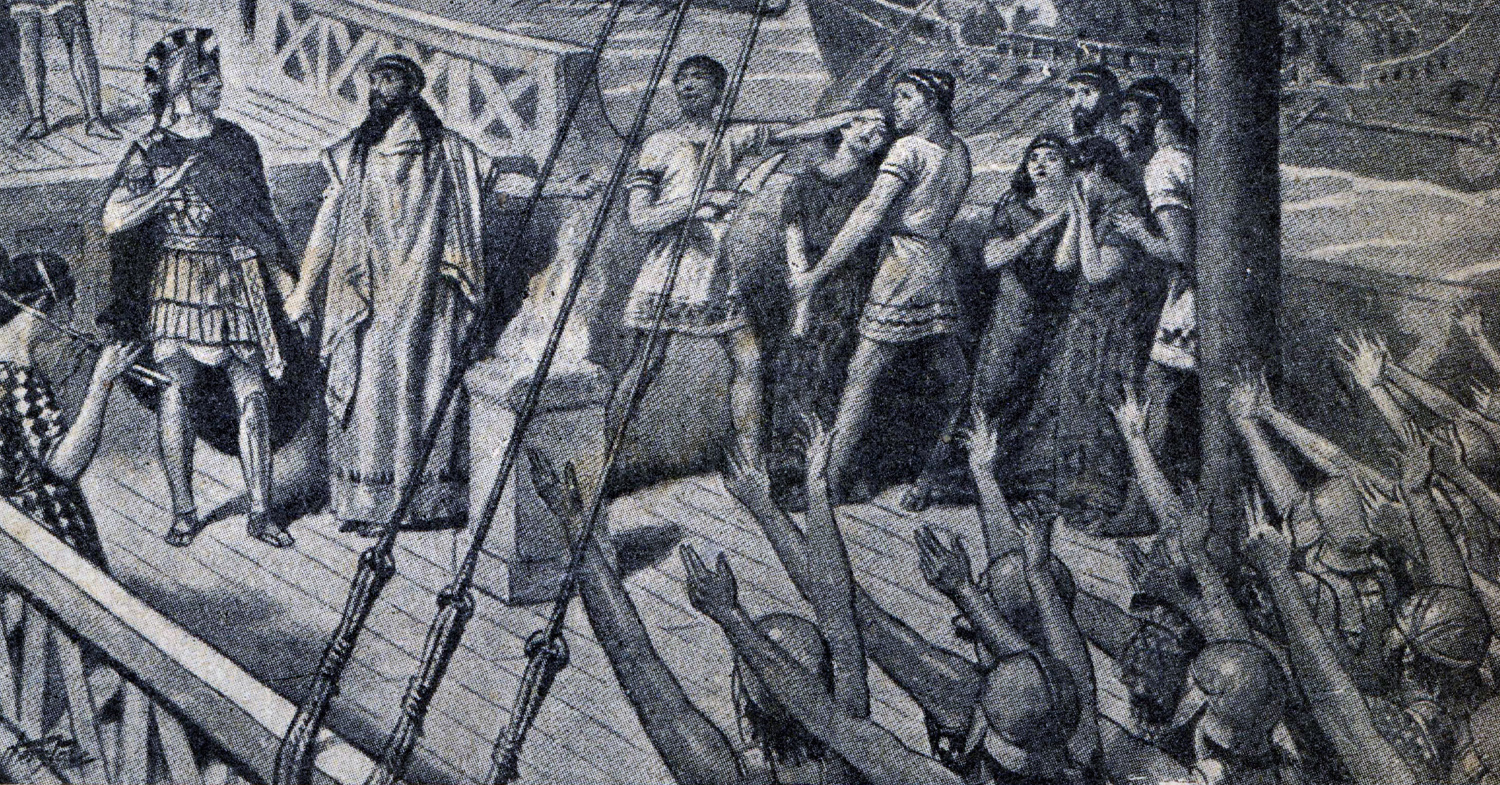
Themistocles Allegedly Conducted A Human Sacrifice Before The Battle of Salamis


Themistocles was an Athenian politician and military strategist who was pivotal in the Greek defeat of the Persian invasion of Greece by Xerxes in 480 BCE. Athens’ great naval strength was in large part due to Themistocles’ influence, as he pushed the Athenians to invest in sea power and to fight Persians in the Aegean. He was the mastermind of the Battle of Salamis, where the Greek coalition navy lured the massive Persian fleet into a narrow strait and delivered a shocking defeat upon Xerxes’ forces. As usually happens, the Greek victory was attributed to sound strategy, stout sailors, and divine aid. Yet, the latter divine component, according to some stories, was gained through unorthodox means. According to legend, Themistocles conducted a human sacrifice in order to cultivate the favor of the gods for his cause.

Plutarch (c. 50-120 CE), the great Greek-Roman biographer, preserved the tale about the human sacrifice of Themistocles in his famous work, the Parallel Lives. He attributed the tale to Phanias of Lesbos (flourished 300 BCE), whom Plutarch described as “a philosopher well read in history” (Life of Themistocles, 13.3).

As the story goes, Themistocles had been preparing an average, human-less, sacrifice in the runup to the Battle of Salamis. A certain prophetic man called Euphrantides, however, had something else in mind to catch the attention of the gods. Central to Euphrantides’ vision was a trio of Persian captives, who presumably came from the upper echelons of society, as they had been wearing elegant clothes and expensive jewelry at the time of their capture. Rumor suggested that the three prisoners were relatives of Xerxes, yet Plutarch admitted that their presumed royal rank was more speculation than proven fact.

When the three Persian prisoners were brought forward, Euphrantides reportedly began crying out for a human sacrifice. He pointed out omens that, according to him, suggested that the gods were eager for the sacrifice to take place. Such omens included the flames of the sacrificial fire rising visibly higher as the Persians neared the altar, and a sneeze—long considered a sign of divine favor or agreement—that rang out from the crowd as the human sacrifice was being discussed. Euphrantides’ mystical charisma, along with the omens that he pointed out, was evidently enough to convince the people to go along with his idea of a human sacrifice.

Themistocles reportedly had some reservations about the sacrifice, but as the people were on Euphrantides’ side, he let the sacrifice commence. Euphrantides was said to have directed the ceremony, but Themistocles or others present had the grisly job of carrying out the sacrifice. The proceedings were mainly catered toward the god Dionysus (or Bacchus), for the prophet claimed that particular deity would be easily swayed by the human sacrifices. Plutarch wrote:

“Themistocles was much disturbed at this strange and terrible prophecy, but the common people, who, in any difficult crisis and great exigency, ever look for relief rather to strange and extravagant than reasonable means, calling up Bacchus with one voice, led the captives to the altar, and compelled the execution of the sacrifice as the prophet had commanded” (Life of Themistocles, 13.3).

It has long been debated whether to categorize the idea of Ancient Greek human sacrifices as legendary or historical. Sporadic descriptions of ancient Greeks conducting human sacrifices can be found in Greek histories and lore, but little archeological evidence has been found to prove the stories true. In 2016, however, the skeleton of a possibly sacrificed ancient Greek individual was found buried at a shrine of Zeus on Mount Lykaion. The skeleton serves as a rare piece of evidence that may back up the legends of ancient Greek human sacrifice. Yet, even so, such sacrifices must have been fairly anomalous in the wider Greek practice of religion.

Written by C. Keith Hansley

Picture Attribution: (Illustration of Themistocles Performing a human sacrifice before the battle of Salamis, created c. 1915, [Public Domain] via Creative Commons).

Sources:
  • Plutarch’s Lives edited by Charles W. Eliot in the Harvard Classics series. New York: P. F. Collier & Son, 1909, 1937.
  • http://penelope.uchicago.edu/Thayer/E/Roman/Texts/Plutarch/Lives/Themistocles*.html 
  • https://www.britannica.com/biography/Themistocles 
  • https://www.britannica.com/event/Battle-of-Salamis 
  • https://www.britannica.com/biography/Xerxes-I  
  • https://www.britannica.com/biography/Phanias 
  • https://www.history.com/news/was-skeleton-unearthed-in-greece-a-human-sacrifice-to-zeus 
  • https://www.smithsonianmag.com/smart-news/did-ancient-greeks-engage-human-sacrifice-180960111/ 
  • https://www.livescience.com/55733-possible-human-sacrifice-to-zeus-discovered.html  

Sunday, December 1, 2019

Pericles Reportedly Had An Elongated Head


Upon viewing statues and paintings of Pericles (c. 495-429 BCE), a common feature can be quickly spotted; he almost always is depicted with a helmet precariously balanced atop his head. The great Greek-Roman biographer, Plutarch (c. 50-120 CE), proposed a reason for Pericles’ helmet headwear. After browsing through the history, folklore and literature that was available to him, Plutarch came to the conclusion that Pericles was depicted with a helmet to minimize a physical abnormality that the great Athenian leader was born with—an elongated head.

Plutarch, in his Parallel Lives, described Pericles as having a head that was “somewhat longish and out of proportion” (Life of Pericles, 3.2). As the historian, Thucydides, and the sculptors and artists of Athens idolized Pericles, Plutarch had to turn elsewhere for evidence of Pericles’ cranial shape. For this purpose, he evidently turned to 5th-century BCE poets and playwrights who were political enemies of Pericles. As those authors were rivals of Pericles, they did not hold back from poking fun at their rival’s deformities. The insult of “squill-head” was apparently a frequent way Pericles’ enemies referred to him, but the most explicit piece of mockery that Plutarch dug up belonged to a comic poet from Athens named Teleclides (flourished 5th century BCE). According to Plutarch, Teleclides wrote of Pericles:

“Fainting underneath the load
Of his own head; and now abroad,
From his huge galley of a pate,
Sends forth trouble to the state.”
(Parallel Lives, Life of Pericles, 3.4)

Thankfully for Pericles, the writings and artworks of his supporters outnumbered and outshined the products of his detractors. Therefore, instead of knowing him as a bulbous-headed rabble-rouser, his image has been preserved as a champion of democracy who happened to always wear a stylish helmet.

Written by C. Keith Hansley

Picture Attribution: (Illustration of a bust of Pericles included in the World’s Greatest Orations Vol. 1, by William Jennings Bryan and Francis Whiting Halsey (c. 1906), [Public Domain] via Creative Commons).

Sources:
  • Plutarch’s Lives edited by Charles W. Eliot in the Harvard Classics series. New York: P. F. Collier & Son, 1909, 1937.
  • http://penelope.uchicago.edu/Thayer/E/Roman/Texts/Plutarch/Lives/Pericles*.html 
  • https://www.ancient.eu/pericles/ 
  • https://www.britannica.com/biography/Pericles-Athenian-statesman 
  • https://oxfordre.com/classics/view/10.1093/acrefore/9780199381135.001.0001/acrefore-9780199381135-e-6260  

Sunday, May 19, 2019

The Athenian Catastrophe At Eretria


In 411 BCE, the once-mighty Athens was in a dire state. Two years prior, Athens had lost tens of thousands of lives (including a few of its greatest generals) and over a hundred ships in their ill-fated expedition to Sicily. Now, with Peloponnesian strength growing and Persian interest in the massive Greek civil war increasing, a group of Athenian officers launched a remarkably ill-timed coup. In 411, conspirators in military and political spheres overthrew the Athenian democracy and, through assassination and intimidation, succeeded in setting up a group of oligarchic leaders in Athens, calling themselves the Four Hundred. Yet, the oligarchs underestimated the pro-democracy passion of the Athenian military and also did not take into account the jealousy that would be felt by the lower ranking oligarchs who were unsatisfied with the power they were allotted after the coup. Ultimately, although the Four Hundred did indeed capture Athens, they were bitterly opposed by the Athenian military (which camped at Samos). At the same time, disgruntled and disillusioned oligarchs plotted against their superiors.

In was at this time, while the Athenian military was in rebellion against the oligarchic government, and while the Athenian people were terrorized by the thoughts of government informants and assassins, that a reported fleet of forty-eight Peloponnesian ships sailed past Athens. The enemy fleet continued along the shoreline of Attica, heading up to the Gulf of Euboea and eventually anchoring in Oropus, on the southern coast of the gulf. The Athenians rightly feared that the Peloponnesian fleet would cut off their access to Euboea and could inspire revolts against Athens in the region. The fear was so powerful that the rival oligarchic factions worked together to mobilize ships to drive off the Peloponnesians. Yet, since the proper Athenian military refused to acknowledge the oligarchs, the city of Athens could only manage to mobilize thirty-eight ships, manned by inadequately-trained sailors and undistinguished officers, and sent them off without much in the way of rations.

The Athenian fleet of thirty-eight ships pursued the Peloponnesians into the Gulf of Euboea. As the Peloponnesians had anchored on the southern shore, the Athenians instead sailed to the north and stopped at the Euboean city of Eretria. With no food onboard their ships and no supply-line set up, the Athenian sailors disembarked and wandered through Eretria in search of food. According to the historian and Athenian general, Thucydides (c. 460-400 BCE), the Eretrians had all of their food stockpiled inland, far away from the coast. Yet, the locals began cooking and serving this food for the Athenians in houses near the inland storehouses.

Although the Eretrian picnic for the Athenian sailors may have seemed friendly, it was all a calculated trap. After Athens suffered its catastrophe in Sicily, many cities under Athenian authority reached out to the Peloponnesians for support in potential rebellions against Athens. Eretria was evidently one such city that wanted to be free from Athenian control. Unfortunately for the Athenian sailors, the Eretrians had been in contact with the Peloponnesian fleet in Oropus and had coordinated a plan on what to do if the Athenians should drop anchor at Eretria. With everything going as planned, the Eretrians somehow signaled to the Peloponnesians, perhaps with smoke from their cooking fires, indicating to the fleet in Oropus that the Athenians were distracted and away from their ships. Seeing this signal, the Peloponnesian fleet set sail and crossed over to the harbor of Eretria before the Athenians ever realized that their foes were on the move.

When the Athenian commander, a certain Thymochares, finally saw that the Peloponnesians were just outside the harbor, he pulled his sailors away from their meals and herded them frantically back to the ships. The surprised and unprepared Athenian fleet sailed out to meet the Peloponnesians and were said to have held their ground for some time. Yet, the Athenian defenses eventually began to give way, and then shattered completely. The defeated sailors fled in at least three directions: some toward a nearby Athenian fort in Euboea, others toward Chalcis, and a third group unfortunately returned to Eretria. By this point, however, the Eretrians were no longer pretending to be friendly, and they slaughtered the unfortunate Athenians who fled back to the city.

According to Thucydides, the Athenian oligarch fleet lost at least twenty-two of their thirty-six ships in the disastrous sea battle at Eretria. In the aftermath of the battle, nearly all of the Euboean cities rebelled against Athens. Yet, the disaster did have one benefit for Athens—it was ammunition that lesser members of the oligarchy could use against the leading oligarchs. Before the end of 411 BCE, the so-called Four Hundred was overthrown and was replaced by the more inclusive Five Thousand, which could be joined by any Athenian man who had the means to purchase a full set of heavy infantry hoplite gear. The Five Thousand became more democratic through reform and eventually gained the approval of the Athenian military, reuniting the city of Athens with its armed forces.

Written by C. Keith Hansley.

Picture Attribution: (Triremes depicted in Ship: The New Student's Reference Work, v. 4, 1914, [Public Domain] via Creative Commons).

Sources:

  • History of the Peloponnesian War (Book VIII) by Thucydides, translated by Rex Warner and introduced by M. I. Finley. New York: Penguin Classics, 1972.    
  • https://www.britannica.com/event/Peloponnesian-War
  • https://www.ancient.eu/Peloponnesian_War/
  • https://www.history.com/topics/ancient-history/peloponnesian-war
  • https://referenceworks.brillonline.com/entries/brill-s-new-pauly/thymochares-e1213040
  • https://www.ancient.eu/Alcibiades/
  • https://www.britannica.com/biography/Alcibiades-Athenian-politician-and-general

Monday, May 13, 2019

The Ravaging Of Mycalessus By Mercenaries During The Peloponnesian War


In 413 BCE, Demosthenes led an army of over 5,000 Athenian and allied forces to Sicily in order to reinforce a preexisting siege of Syracuse. A certain band of around 1,300 tardy Thracian mercenaries was meant to be sailing with that army, but when the swords-for-hire arrived in Athens, they found that Demosthenes had already sailed away. The jobless Thracians then renewed the offer of their military services to the city of Athens, which at that time was plagued by the presence of a nearby Spartan stronghold that had recently been built at Decelea, in the Athenian heartland of Attica. Although the Thracians were helpful in countering Peloponnesian raids, the Athenians decided that the mercenary company was too expensive to keep around. Athens eventually forced the Thracians to leave, but as they headed home to Thrace, the mercenaries were paid for one last job.

Athens tasked the homeward-bound Thracian mercenaries with the job of spreading chaos in the Spartan-aligned regions of Greece as they traveled back to Thrace.  To help with this mission, the Athenians apparently gave the Thracians an advisor (or possibly a general), as well as a fleet of transport ships. The Thracians sailed these transports along the coast of Greece, intending to sail into the Euboean Gulf, but they took a detour to raid Tanagra, on the borderland between Attica and Boeotia. After rushing back to their ships with the plunder, the mercenaries passed through the Euripus Strait between Euboea and mainland Greece, continuing to sail along the Boeotian shoreline.

Yet, before the Thracians sailed too far from the Euripus Strait, they disembarked on Boeotian soil and began marching inland. For unknown reasons, but perhaps on direction from their Athenian advisor, the Thracians continued marching inland until they reached an uninformed and poorly defended city called Mycalessus. It was a settlement seemingly devoted to farming, with little else of note except a few modest shrines and a large school for boys. Perhaps the city also catered to travelers, for there was a sizable temple of Hermes located only two miles away from the town. As Mycalessus was well inland and not a power player in the region, the people there had unfortunately let their guard down. The city was ill-protected by an inadequate garrison, and, although the city did have walls, the defensive features of the settlement were dilapidated and crumbling. Unfortunately, as the city also apparently had little in the way of scouts or patrols, Mycalessus left its gates wide open and it walls virtually undefended. The city remained in this sorry state as the army of Thracian mercenaries marched ever closer.

Eventually, the mercenaries arrived at the aforementioned temple of Hermes, which lay about two miles out from the city. Even then, the city of Mycalessus apparently still had no knowledge of the danger they were in. The mercenaries spent the night camped by the temple, but once daybreak arrived, they quickly rushed across the two mile stretch to the city and assaulted the unprepared people of Mycalessus. When the mercenaries attacked, the gates were still open, the wall still had gaps, and the garrison of the city was still understaffed. The Athenian general and historian, Thucydides (c. 460-400 BCE), wrote of this event in his History of the Peloponnesian War and his account infers that the city fell without a battle—the mercenaries were able to break in and immediately begin pillaging.

For no stated reason, the mercenary army’s occupation of Mycalessus became a bloodbath. According to Thucydides, “The Thracians burst into Mycalessus, sacked the houses and temples, and butchered the inhabitants, sparing neither the young nor the old, but methodically killing everyone they met, women and children alike, and even the farm animals and every living thing they saw” (History of the Peloponnesian War, Book VII, section 29). As happened with the city’s temples and houses, the boys’ school of Mycalessus was also invaded, and all of the schoolchildren who had gone to class that morning were reportedly massacred by the mercenaries. Thucydides’ sympathy for the city is palpable in his writing. He stated: “Mycalessus lost a considerable part of its population. It was a small city, but in the disaster just described its people suffered calamities as pitiable as any which took place during the war” (History of the Peloponnesian War, Book VII, section 30).

Fortunately for the survivors of Mycalessus, the city of Thebes had a competent intelligence network and learned of the attack quickly. A respected Boeotian commander named Scriphondas mobilized the forces of Thebes and rushed to the aid of Mycalessus. The Thebans caught the mercenaries unawares and unprepared. Some Thracians were still pillaging in the city at the time, while the majority were back out in the field. Upon the arrival of the Boeotians, the mercenaries apparently abandoned any of their comrades still inside the city and began an orderly withdrawal back toward their ships. The main contingent of Thracians was able to escape to the coast by carefully alternating between advance and retreat against the pursuing Thebans. Any mercenaries still inside the city, however, were said to have been killed by the newly arrived Boeotians forces.

When the embattled Thracian mercenaries reached the sea, a problem quickly developed. The Thebans had chased the mercenaries to the coast and the Thracians had not been able to fully embark on the ships before Boeotian archers forced the transports to sail out of arrow range. Many mercenaries found themselves stranded and some were either slain on the beach or drowned as they tried to swim to the transports. Although the majority of the mercenaries had escaped, a reported 250 Thracians died during the Theban counter-attack at Mycalessus or on the beach. The casualties of the Theban relief force was much lighter, with twenty men reported dead. Unfortunately, the leader of the Theban army, Scriphondas, was among the dead.

Written by C. Keith Hansley.

Picture Attribution: (Scene depicting Aphrodite saving Aeneas, Etruscan black-figure amphora, ca. 480 BC. Martin-von-Wagner-Museum, L 793, [Public Domain] via Creative Commons).

Sources:

  • History of the Peloponnesian War by Thucydides, translated by Rex Warner and introduced by M. I. Finley. New York: Penguin Classics, 1972.

Tuesday, April 30, 2019

The Sacrifice Dilemma At The Battle Of Marathon


By 490 BCE, King Darius I of Persia had brought Ionia, Thrace and Macedonia under his influence and began his presumptive next phase of subjugation by sending an expeditionary force into Euboea. The Persian expeditionary force (estimated to have numbered anywhere from 15,000 to 30,000 troops) crossed over to Attica, where they were intercepted by an army of around 10,000 Athenians and Plataeans on the plains of Marathon. Herodotus claimed that the Greek forces gave sacrifice to the gods before the battle and watched for omens, which, when found, were interpreted as signs of a good outcome. Although not mentioned by Herodotus, Athenian tradition and future historians (such as Xenophon and Plutarch) claimed that one of the religious actions taken by Athens before the Battle of Marathon was a vow to the goddess, Artemis, that, if Greece should prove victorious, they would sacrifice to her a number of animals equal to the number of Persians killed in the battle. When they made this sacred vow, they likely did not know just how big a task they were arranging.

According to Xenophon and Plutarch, Athens promised to sacrifice young goats (kids) to Artemis. Yet, in the scholia to Aristophanes’ The Knights, it was claimed that the Athenians actually promised oxen to the goddess. Whatever the case, promising either goats or oxen, the Greeks charged against the Persians, hoping that their vow of a future sacrifice would bring the gods over to their side. The ensuing Battle of Marathon would become one of the most famous engagements of the ancient world and a key point in the development of a panhellenic Greek identity—it would also, unfortunately, lead to the deaths of untold numbers of livestock.

The Greeks won a major victory at Marathon, and, despite being greatly outnumbered, they reportedly only lost 192 men in the battle. In contrast, Herodotus claimed that 6,400 Persians were killed, which was seemingly calculated on the assumption that a hundred Persians were slain for every three Greek deaths. Although Herodotus gave the Greeks a favorable statistic for the number of Persian dead, many the of historian’s ancient Greek peers apparently believed Herodotus’ account of the Battle of Marathon was maliciously unembellished. For instance, Plutarch wrote in his essay, The Malice of Herodotus, that the statistic of Persian dead should be increased from Herodotus’ claim of 6,400 to one in which “the number of the dead [is] appearing infinite” (section 26).

In any case, whether or not the number of Persian dead was closer to six thousand or infinity, the Athenians owed Artemis an incredible number of sacrificial animals. Although the account from the scholia of Aristophanes claimed the Athenians had originally promised oxen, the story went on to propose that Athens downgraded to goats after they discovered just how many Persians they had killed. Faced with the challenge of rounding up and sacrificing thousands of goats, the Athenians decided to make a pragmatic emendation to their vow with Artemis. Instead of sacrificing the goats in bulk, they made the decision to offer the sacrifices in yearly increments. Writing around a century or more years later, Xenophon (c. 420-350 BCE) commented on the subject, claiming, “They had made a vow to Artemis that they would offer her in sacrifice a goat for every enemy soldier they killed, but they couldn’t find enough goats and so they decided to sacrifice five hundred a year, and they are still carrying out this annual sacrifice” (Anabasis, Book 3, section 2). Most ancient sources agreed with Xenophon that the sacrifices were in increments of 500, but Aelian, in his Various History, claimed that the yearly sacrifices amounted to the favored Greek number of 300.

Written by C. Keith Hansley

Picture Attribution: (Pheidippides giving word of victory at Marathon, painted by Luc-Olivier Merson (1846–1920), [Public Domain] via Creative Commons).

Sources:
  • Anabasis Kyrou (The Expedition/Upcountry March of Cyrus) by Xenophon and translated by Robin Waterfield. New York: Oxford University Press, 2005.
  • http://www.perseus.tufts.edu/hopper/text?doc=Perseus%3Atext%3A2008.01.0352%3Asection%3D26 
  • https://www.britannica.com/event/Battle-of-Marathon 
  • https://www.ancient.eu/marathon/ 
  • https://www.livius.org/articles/battle/marathon-490-bce/the-significance-of-marathon/ 
  • https://www.nationalgeographic.org/thisday/sep12/battle-marathon/ 
  • https://www.history.com/topics/ancient-history/battle-of-marathon  

Tuesday, April 9, 2019

General Demosthenes’ Night Of Madness At Syracuse


In 413 BCE, Demosthenes sailed to Sicily and arrived at the outskirts of Syracuse with around seventy-three ships and thousands of troops to reinforce the Athenian camp that was besieging the city. The fresh troops and ships were much appreciated, as the Syracusans had recently captured three Athenian forts, and ships from Syracuse had even forced the Athenian expedition fleet to retreat during a later sea battle. The Athenians had always considered themselves to be unbeatable at sea, so the naval defeat was extremely troubling. Yet, the arrival of Demosthenes with his ships and men gave the Athenians a much-needed boost in morale.

Demosthenes shared the command of the Athenian expeditionary force with two other generals, Eurymedon and Nicias. Now that the expedition force was replenished, the three generals decided that it was time to attack Syracuse. After assessing the local geography, Demosthenes decided that the best way to defeat Syracuse’s defenses was to occupy Epipolae, an elevated plateau that was defended by several Syracusan camps and forts, as well as a wall. First, the Athenians tried a direct attack, marching out with siege engines to capture the wall, but the engines were burned and the assault made little progress. Thwarted, Demosthenes began to think of an alternative way to capture Epipolae. As one of the most creative and unorthodox generals in the Athenian military, Demosthenes was adept at planning unusual and surprising methods of attack. During his career, Demosthenes’ creative style of leadership had led to miraculous victories; yet, his ideas were also known to sometimes go horribly awry.

Ultimately, Demosthenes decided to try a stealth attack after dark. Around midnight, Demosthenes led his army in a roundabout path and climbed up onto the plateau from the west. The Athenians successfully arrived at the first fort of Epipolae without having been discovered. With the first step complete, Demosthenes then attacked the unprepared Syracusans, catching the garrison inside completely off guard. The Athenian forces quickly defeated the surprised warriors and captured the fortification. The battle for the fort was a complete Athenian victory, yet the overarching battle for Epipolae was about to take a dramatic turn.

Although the Athenians had successfully taken the first fort of the plateau, survivors from the defeated garrison and the noise of battle had alerted the defenders of Syracuse to the attack. Waves of Syracusans began rushing toward the fort, and the first defenders to arrive were approximately 600 warriors from one of the other forward camps on the plateau. It was a sizable force, but not enough to defeat the army that Demosthenes had led into battle. The Athenians rushed against the new arrivals and easily cut them down. As the band of 600 Syracusans gave way, the Athenians pursued them deeper into Epipolae. Yet, in their pursuit, the Athenians began to lose their cohesion and discipline, a troubling occurrence for any battle, but especially deadly at night. Consequently, the Athenian forces were in a haphazard formation when the fully-mobilized army from Syracuse arrived to assist the forts and defend Epipolae.

Unorganized and surrounded by the dark of night, the Athenians reportedly bumbled into a band of Boeotians who, along with other Spartan-aligned Greeks, were fighting on the side of Syracuse. The Boeotians entered the battlefield with discipline and attacked as a whole against the jagged Athenian lines. The shock of the Boeotian charge sent the Athenians into a panic, and, to Demosthenes’ horror, his army began to scatter into the night.

Instead of conquering Epipolae, Demosthenes now had to gather his shattered army and herd them back to camp. It was reportedly a scene of utter confusion. Many Athenians, after running off, became lost in the dark—some were said to have run straight off the plateau cliffs. Others called out to humanoid shadows in the dark, asking for watchwords. Yet, before long, the Syracusans learned the Athenian watchword and used it to lure lost stragglers to captivity or death. Some stranded warriors from the Athenian side even tried singing battle songs and other tunes that were native to their homelands. Nevertheless, such eerie songs emanating from the darkness only added to the confusion, especially when the songs of friend and foe sounded similar.

Eventually, Demosthenes and the majority of his army escaped and safely returned to camp. Yet, many were missing. Apparently, the portion of the Athenian army that fared the worst was the new arrivals that had recently sailed in with Demosthenes. As they had not yet learned the local landscape, they were the most prone to losing their way in the Sicilian countryside or falling off a cliff in the dark of night.

Written by C. Keith Hansley.

Picture Attribution: (Darkened version of “Heroes of the Battle of Marathon”, painted by Georges Marie Rochegrosse (1859–1938), [Public Domain] via Creative Commons).

Sources:
  • History of the Peloponnesian War by Thucydides, translated by Rex Warner and introduced by M. I. Finley. New York: Penguin Classics, 1972.