Showing posts with label Dark. Show all posts

Tuesday, December 10, 2019

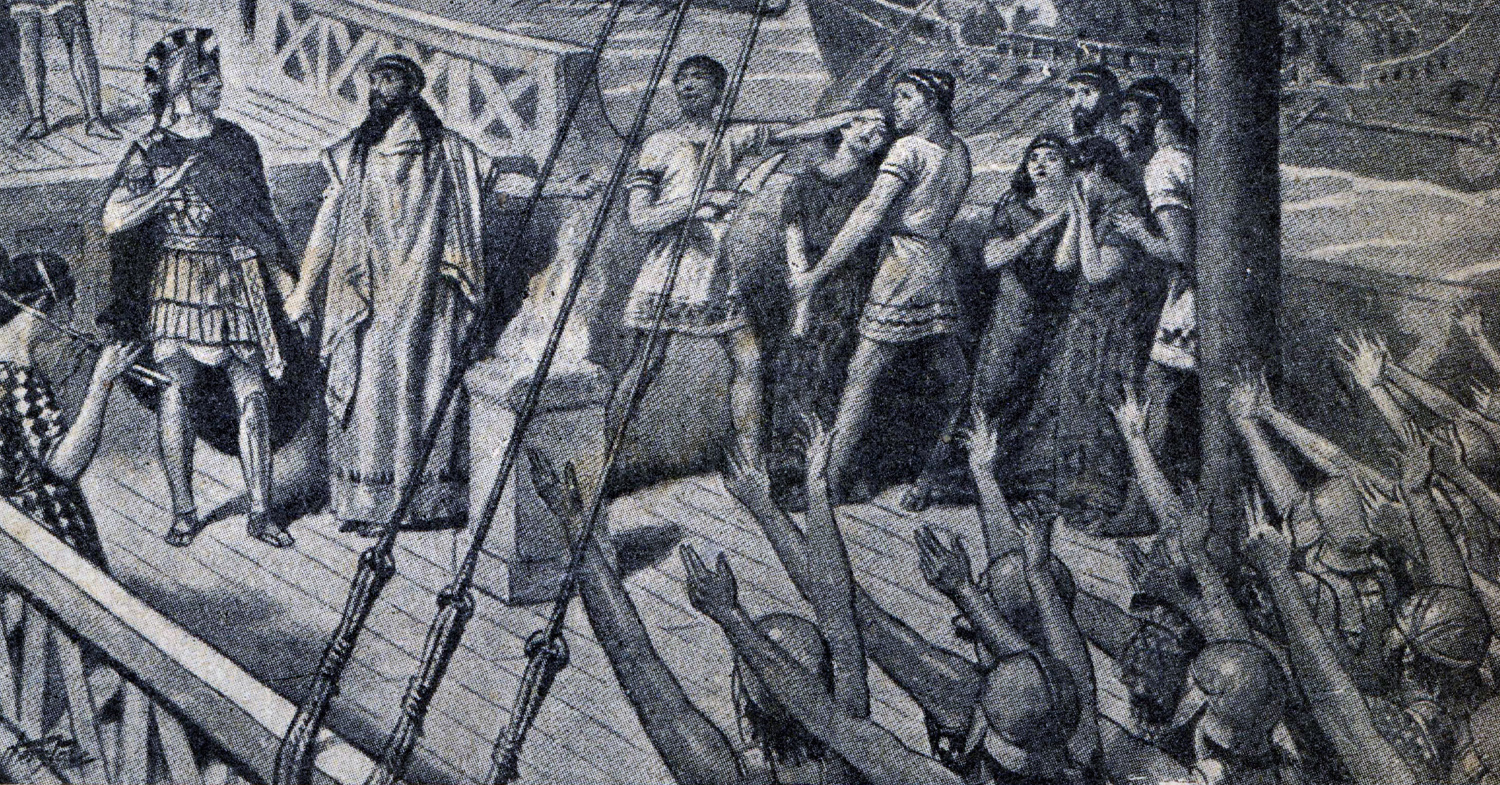
Themistocles Allegedly Conducted A Human Sacrifice Before The Battle of Salamis


Themistocles was an Athenian politician and military strategist who was pivotal in the Greek defeat of the Persian invasion of Greece by Xerxes in 480 BCE. Athens’ great naval strength was in large part due to Themistocles’ influence, as he pushed the Athenians to invest in sea power and to fight Persians in the Aegean. He was the mastermind of the Battle of Salamis, where the Greek coalition navy lured the massive Persian fleet into a narrow strait and delivered a shocking defeat upon Xerxes’ forces. As usually happens, the Greek victory was attributed to sound strategy, stout sailors, and divine aid. Yet, the latter divine component, according to some stories, was gained through unorthodox means. According to legend, Themistocles conducted a human sacrifice in order to cultivate the favor of the gods for his cause.

Plutarch (c. 50-120 CE), the great Greek-Roman biographer, preserved the tale about the human sacrifice of Themistocles in his famous work, the Parallel Lives. He attributed the tale to Phanias of Lesbos (flourished 300 BCE), whom Plutarch described as “a philosopher well read in history” (Life of Themistocles, 13.3).

As the story goes, Themistocles had been preparing an average, human-less, sacrifice in the runup to the Battle of Salamis. A certain prophetic man called Euphrantides, however, had something else in mind to catch the attention of the gods. Central to Euphrantides’ vision was a trio of Persian captives, who presumably came from the upper echelons of society, as they had been wearing elegant clothes and expensive jewelry at the time of their capture. Rumor suggested that the three prisoners were relatives of Xerxes, yet Plutarch admitted that their presumed royal rank was more speculation than proven fact.

When the three Persian prisoners were brought forward, Euphrantides reportedly began crying out for a human sacrifice. He pointed out omens that, according to him, suggested that the gods were eager for the sacrifice to take place. Such omens included the flames of the sacrificial fire rising visibly higher as the Persians neared the altar, and a sneeze—long considered a sign of divine favor or agreement—that rang out from the crowd as the human sacrifice was being discussed. Euphrantides’ mystical charisma, along with the omens that he pointed out, was evidently enough to convince the people to go along with his idea of a human sacrifice.

Themistocles reportedly had some reservations about the sacrifice, but as the people were on Euphrantides’ side, he let the sacrifice commence. Euphrantides was said to have directed the ceremony, but Themistocles or others present had the grisly job of carrying out the sacrifice. The proceedings were mainly catered toward the god Dionysus (or Bacchus), for the prophet claimed that particular deity would be easily swayed by the human sacrifices. Plutarch wrote:

“Themistocles was much disturbed at this strange and terrible prophecy, but the common people, who, in any difficult crisis and great exigency, ever look for relief rather to strange and extravagant than reasonable means, calling up Bacchus with one voice, led the captives to the altar, and compelled the execution of the sacrifice as the prophet had commanded” (Life of Themistocles, 13.3).

It has long been debated whether to categorize the idea of Ancient Greek human sacrifices as legendary or historical. Sporadic descriptions of ancient Greeks conducting human sacrifices can be found in Greek histories and lore, but little archeological evidence has been found to prove the stories true. In 2016, however, the skeleton of a possibly sacrificed ancient Greek individual was found buried at a shrine of Zeus on Mount Lykaion. The skeleton serves as a rare piece of evidence that may back up the legends of ancient Greek human sacrifice. Yet, even so, such sacrifices must have been fairly anomalous in the wider Greek practice of religion.

Written by C. Keith Hansley

Picture Attribution: (Illustration of Themistocles Performing a human sacrifice before the battle of Salamis, created c. 1915, [Public Domain] via Creative Commons).

Sources:
  • Plutarch’s Lives edited by Charles W. Eliot in the Harvard Classics series. New York: P. F. Collier & Son, 1909, 1937.
  • http://penelope.uchicago.edu/Thayer/E/Roman/Texts/Plutarch/Lives/Themistocles*.html 
  • https://www.britannica.com/biography/Themistocles 
  • https://www.britannica.com/event/Battle-of-Salamis 
  • https://www.britannica.com/biography/Xerxes-I  
  • https://www.britannica.com/biography/Phanias 
  • https://www.history.com/news/was-skeleton-unearthed-in-greece-a-human-sacrifice-to-zeus 
  • https://www.smithsonianmag.com/smart-news/did-ancient-greeks-engage-human-sacrifice-180960111/ 
  • https://www.livescience.com/55733-possible-human-sacrifice-to-zeus-discovered.html  

Wednesday, November 13, 2019

Crocell—An Underwhelming Demon Who Supposedly Excels At Warming Baths


Crocell, according to occultists, is a spiritual being or demon with powers related to water. According to legend, he was one of 72 demons supposedly controlled by the biblical King Solomon. These demons, listed and described in a peculiar grimoire called the Lemegeton (or the Lesser Key of Solomon) are said to have all sorts of flashy abilities, including teleportation, fortune telling, control of weather, physical transformation, emotion manipulation, the spreading of disease, and the poltergeist-like ability to topple structures by sheer spiritual force. Poor Crocell, however, is not said to wield any of these powers.

In appearance and ability, Crocell comes across as a humble demon with humble powers. Whereas other spirits in the Lemegeton are described as having monstrous shapes, riding on bizarre mounts, and having gravelly voices, Crocell apparently has no steed and prefers to be seen in his original angelic fallen-angel appearance. As said earlier, Crocell’s abilities are said to be connected to water. For one, he can make the sound of water fill the air, even when there is no water present. Besides that, the Lemegeton claims Crocell can additionally “warmeth Waters, and discovereth Baths” (Lesser Key of Solomon, Shemhamphorash, 49). If finding and warming baths were not enough, Crocell also apparently is quite good at geometry. While these abilities are not as grandiose as teleportation or the power to smite cities, Crocell’s bath warming prowess supposedly has earned him dominion over 48 legions of lesser spirits.

Written by C. Keith Hansley


Picture Attribution: ('Imperial' porcelain roll-rim bath. Plate 1090-G, (c. late 19th century) and an image from The Violet Fairy Book (1906), [Public Domain] via Creative Commons).


Sources:
  • The Three Magical Books of Solomon by Crowley, Mathers and Conybear. Vega Publishing, 2019 (original publications c. 1888, 1898, 1904. 
  • https://www.sacred-texts.com/grim/lks/lks05.htm 
  • https://www.sacred-texts.com/grim/lks/index.htm  

Tuesday, June 25, 2019

The Tragic Battle Of Two Witches During The Pontificate of Nicholas V


A certain Germanic bishop arrived in Rome during the pontificate of Pope Nicholas V (r. 1447-1455) and had quite an adventure while he stayed in the holy city. His story was recorded by the Inquisitors, Heinrich Kramer and James Sprenger, in their infamous Malleus Maleficarum (published around 1487). According to the Inquisitors, the German bishop reportedly fell in love with a Roman ‘girl’ (their description) and he decided to make her his concubine. In exchange for accompanying him back to the seat of his German bishopric, he offered to house her somewhere with nice accommodations and access to servants and wealth. When the bishop shared this plan with his lady love, the girl agreed, but made one condition—she wanted her mother to be allowed to live with her in the bishop’s diocese. The bishop and his paramour came to an agreement and the girl (and her mother) apparently set off for German lands while the bishop finished his business in Rome.

Although the bishop likely wanted to keep a low profile at this point, it only took one day for his life to erupt into scandal and drama. On the next night after the holy man and his concubine had made their arrangement, the bishop fell seriously ill. He was in great discomfort, and felt so hot in the throat and chest that he constantly requested chilled water to cool himself down. The bishop’s advisors and caretakers were shocked by the suddenness of the ailment and they quickly became convinced that something nefarious was afoot. If the illness was not caused by poison, then they were sure the only other cause could be witchcraft. When the bishop was still ill after three day’s time, and normal medical practices were showing no signs of bringing him back to health, the bishop’s servants began to consider more radical methods for a cure. According to the Malleus Maleficarum, the bishop’s servants brought in a local healer, who was considered a benevolent witch.

The healer examined the sickly bishop, and, according to the Malleus Maleficarum, she told her patient, “Your illness has been caused by a spell of witchcraft, and you can only be healed by another spell, which will transfer the illness from you to the witch who caused it, so that she will die” (Part II, question 2, intro). The healer-witch’s words apparently convinced the bishop, and, as he evidently did not think that, nature, medicine, or God would protect him from his illness, he decided that the good witch’s counterspell was his only option. Yet, as the bishop was still in Rome, he resolved to leave his fate in the hands of the pope. Therefore, the bishop sent word to Pope Nicholas V, informing him of his situation and the possible magical cure. The Malleus Maleficarum described the pope’s alleged reaction: “Now the Holy Father loved him [the bishop] very dearly, and when he learned that he could only be healed by the death of the witch, he agreed to permit the lesser of two evils, and signed this permission with his seal” (Part II, question 2, intro). With the support of the Vicar of Christ on his side, the bishop eagerly hired the services of the healer-witch and allowed her to cast her counterspell.

Unfortunately, the aforementioned young concubine had apparently caught whatever illness was plaguing the bishop, and her symptoms began to show at this very inopportune moment. The phrase, ‘correlation does not imply causation’ was incredibly underutilized by witch-hunters, and, unsurprisingly, everyone privy to the bishop’s condition and cure quickly came to believe that the girl was made ill by the healer’s counter-spell, and therefore had to be a witch. When the bishop recovered enough strength to travel, he went to meet with the sickly girl he once intended to have as a concubine. Now, however, he was convinced that she was a witch, and his ultimate goal in meeting with her was to convince her to repent for her alleged witchcraft. As the bishop’s illness and the healer-witch’s convincing words had brought her life to ruin, the Roman girl understandably was irate when she saw the bishop—after all, her short time spent with him had given her a deadly illness and a scandalized reputation. The Malleus Maleficarum described the tense interaction: “the Bishop went out of compassion to visit the girl; but when he entered the room, she received him with horrible execrations, crying out: May you and she who wrought your cure be damned for ever!” (Part II, question 2, intro). The illness, unfortunately, affected the girl much worse than it had the bishop. She reportedly did not recover from whatever it was that afflicted her and faced an unpleasant death. As the Malleus Maleficarum unpityingly stated, she “died miserably. But the Bishop returned home with joy and thankfulness” (Part II, question 2, intro). The bishop did, however, die at some point before the publication of the Malleus Maleficarum around 1487.

Interestingly, Heinrich Kramer and James Sprenger realized that others might use this story as an excuse to make contracts with witches. Therefore, at the end of the story, they were obligated to remind the reader that witchcraft is bad, and that holy water, blessed salts, and exorcisms are better cures than the practices of folk healers. Ultimately, however, they could not come up with a convincing reason as to why the pope and a bishop could hire a witch without consequence, whereas a peasant might hire a witch and face severe or fatal repercussions. Nevertheless, they did attempt an explanation, which resulted in this awkward passage: “Here it is to be noted that a privilege granted to one does not constitute a precedent for all, and the dispensation of the Pope in this case does not argue that it is lawful in all cases” (Part II, question 2, intro).

Written by C. Keith Hansley

Picture Attribution: (Combination of a painting with Pope Nicholas V by Antonio Montúfar (active 1614-1629) with a painting of Shakespearean witches by Daniel Gardner (1750–1805), both [Public Domain] via Creative Commons).

Sources:
  • The Malleus Maleficarum by Heinrich Kramer and James Sprenger, translated by Montague Summers (Dover Publications, 1971). 
  • https://www.britannica.com/biography/Nicholas-V-pope 
  • http://www.newadvent.org/cathen/11058a.htm 
  • https://www.encyclopedia.com/people/philosophy-and-religion/roman-catholic-popes-and-antipopes/nicholas-v

Monday, June 17, 2019

The Mass-Murdering Convulsions Of John Smith Of Leicester


In the early 17th century, a young boy named John Smith stirred up fears of witchcraft in the town of Husbands Bosworth, in Leicester, England. His condition, possibly epilepsy or hystero-epilepsy, manifested in his childhood and his convulsions were visibly shocking to his family and their friends. These worrying parents and guardians, however, were no common folk. John Smith came from a prominent family—his father was Sir Roger Smith; his uncle was the silver-tongued sermonizer, Henry Smith; and his grandfather, Erasmus Smith, was Bosworth’s Lord of the Manor. As the boy was of noble blood, his concerned family friends also were prominent figures. One such acquaintance was Sir Henry Hastings, who took special interest in defending the boy against a perceived demonic threat.

Sir Henry Hastings was the High Sheriff of Leicester between 1607-1608. While Sir Henry was serving in that capacity, John Smith (reportedly four or five years old at the time) began behaving oddly and started to suffer afflictions that resembled seizures. The possibility of witchcraft quickly came to people’s minds, and Sir Henry Hastings questioned several suspicious persons in that regard. Yet, no known convictions for bewitching the boy were brought about during Sir Henry’s term as High Sheriff.

Although Sir Henry Hastings could not convict any witches between 1607 and 1608, the idea that witchcraft was involved must have festered in him and the boy’s family for years. Their fears could only grow as young John Smith’s condition persisted during his childhood, and the family apparently reached a breaking point in 1616, when the boy was 12 or 13 years old. A certain alderman named Robert Heyrick described the hysteria caused by John Smith’s disorder in Bosworth. In a letter dated July 18, 1616, Heyrick claimed that the boy would fall into fits where he loudly struck his own chest hundreds of times. Many of the well-to-do citizens of the town witnessed the episodes, and the aforementioned Sir Henry Hastings tried to stop the boy from causing any self-harm. Heyrick wrote (in ye olde English, mind you), “Sir Henry Hastings hath doon what he colld to hold him in his fit; but he and another as strong as he could not hold him; yf he might have his arm at liberty he woolld stryke himsellfe suche bloes on his brest, being in his shirt, that you myght here the sound of yt the length of a long chamber” (Letter of Alderman Heyrick to Sir William, July 18, 1616).

The family of John Smith was apparently so desperate to cure the troubled boy that they brought in several so-called Wise Women, or rural healers, whose knowledge of herbal and folk remedies made them frequent targets of witch-hunters. Alderman Heyrick, in his letter, mentioned the visits of these Wise Women, writing “When he [John Smith] was in his fyt, they [the Wise Women] were soomtymes brought to him, and then they were chardged to speake sarten words…at the end of the last he woolld fall out of his fit as quyetly as if one did lay him doune to slepe” (Letter of Alderman Heyrick to Sir William, July 18, 1616). Although these healers were apparently able to bring the boy out of his fits, their cures were not permanent. The failure of the women to totally cure the boy no doubt frustrated and angered the fearful family, yet, for the healers, it was their patient, John Smith, who would be the most dangerous foe.

Sometime during the first months of 1616, likely after being treated by some of the Wise Women, young John Smith began accusing the healers and their associates of being the cause of his affliction. The boy’s family and the local judicial system agreed with the accusation and the Bosworth Witch Trials were begun. By the time that Alderman Heyrick began writing his letter on July 18, 1616, the witch-hunt had been in full swing for four or five days. In that time, the authorities had filled their jails with suspected witches, and “9 of them shal be executed at the gallows this fornone, for bewitching of a younge gentellman of the age of 12 or 13” (Letter of Alderman Heyrick to Sir William, July 18, 1616). Unfortunately, the nine women mentioned here were indeed executed by hanging because of the boy’s claims.

Ironically, it was the witch-obsessed King James (VI of Scotland, I of England) who put an end to the Bosworth Witch Trials. The king arrived in the chaotic town in mid-August, 1616. At the time, the first nine women had already been executed, but six more were still imprisoned on suspicion of witchcraft.  During his short stay in town, King James took interest in the trial and interviewed John Smith. Yet, the king had encountered false charges from children before, and when he watched and listened to the troubled boy, something caused James to be skeptical. Believing either the witchcraft accusations, or the fits, themselves, were completely fraudulent, King James sent John Smith to be interrogated by Archbishop Abbot of Canterbury. The archbishop came to the same conclusion as the king, and young John Smith eventually confessed that he had falsely accused all of the women. When the confession was brought to King James, he had the imprisoned women released without a trial. Tragically, one of the six captive women died before she could be released, bringing the deaths resulting from John Smith’s accusations to a total of ten.

Written by C. Keith Hansley

Picture Attribution: (Scene of a witch trial by Joseph E. Baker (1837-1914), Public Domain via Creative Commons).

Sources:
  • The Demonology of King James I (introduction), edition of Donald Tyson (Llewellyn Publications, 2011).
  • https://www.jstor.org/stable/pdf/3693732.pdf 
  • https://husbandsbosworth.info/historical-information/bosworth-witches 
  • https://www.britannica.com/science/hystero-epilepsy

Tuesday, June 11, 2019

The Torments Of Bishop Priscus Of Lyon


A clergyman named Priscus succeeded Saint Nicetius as the bishop of Lyon in 573. That same year also saw the election and consecration of Bishop Gregory of Tours. Gregory held a grudge against Bishop Priscus for various reasons, some of them plain, others more vague. For one, Priscus reportedly tried to defame Saint Nicetius (a relative of Gregory), and also was said to have persecuted the late Nicetius’ friends in Lyon. Besides the attacks on Nicetius’ legacy, Gregory also took offense at Bishop Priscus being a married man with children. Unfortunately for Priscus, Gregory of Tours was a prolific writer whose History of the Franks would become the main source for information on 6th-century France. When, in the narrative of his History, it came time to introduce Bishop Priscus into the historical narrative, Gregory of Tours decided to avenge his kinsman by doing some defaming of his own.

Interestingly, the behavior of Bishop Priscus and his wife, Susanna, inspired (at least according to Gregory) the wrath of supernatural forces, including the spirit of the late Saint Nicetius. At first, the hauntings seemed concentrated on the church-house (or rectory). One deadly incident occurred when Bishop Priscus decided to add another floor to the building. As construction was ongoing, an unnamed deacon who had been an enemy of Nicetius (and therefore an ally of Priscus) reportedly climbed up to the construction area. As the deacon, standing atop a beam, was surveying the builders’ progress, he reportedly muttered some rude words about the late saint-bishop. According to Gregory of Tours, it was only mere seconds after this disparaging comment that the wood on which the deacon stood collapsed, and he fell to his death. Unfortunately, the deacon would not be the last victim of the supposedly haunted holy house.

A major catalyst for the supposed hauntings of Priscus and his family was the entry of the bishop’s wife, Susanna, into the rectory despite a “rule long observed by earlier bishops that no woman should go into the church-house” (Gregory of Tours, HF, Book 4, section 36). Susanna’s presence in the church-house was one thing, but the conduct of husband and wife in their alone time was another thing, entirely. The ghost of Saint Nicetius apparently was aghast that Priscus and Susanna had other things in mind at night besides singing hymns and taking Communion—the saint’s spirit would even reportedly invade the dreams of more pious members of the clergy to go interrupt the naughty Bishop Priscus. As told by Gregory of Tours, “While the Bishop and his wife were misconducting themselves in this perverse way, Saint Nicetius appeared in a dream to a certain man. ‘Go,’ said he, ‘and tell Priscus to stop behaving so badly and to mend his ways’” (HF, 4. 36).

As was curiously not uncommon in the tales of several medieval saintly spirits, the ghost of Nicetius could become quite vengeful (and violent) if he was disobeyed or ignored. In the case of one deacon who had received orders from the spirit but did not carry them out, Gregory claimed that once the man fell asleep, “Nicetius began to hit him in the throat with his clenched fists. When the day dawned, the deacon’s throat was painfully swollen” (HF, 4. 36).

When sending messengers via dream invasions did not work to halt Bishop Priscus’ behavior, the ghostly Saint Nicetius reportedly took a more direct route for punishment. In a Biblical-style supernatural affliction, the saintly spirit was said to have administered on Priscus’ entire family a hefty dose of holy madness. Gregory of Tours vividly described the peculiar scene:

“In the end God in His majesty took vengeance on the family of Bishop Priscus for these sins. His wife Susanna was possessed of a devil. In her madness she ran through the whole city, with her hair loose about her shoulders, confessing that this holy man of God [Nicetius], whom she had denied while she still had her wits, was in fact Christ’s friend, and calling upon him to spare her. The Bishop was seized with a quartan ague [malarial fever] and began to shake. When he recovered from his ague, he continued to tremble and was dull-witted. His son and his whole household became white in the face and lost their wits, too, and it was clear to all that Saint Nicetius had struck them with his miraculous power” (HF, 4. 36).

The dull-wittedness and trembling must have disappeared or subsided to a manageable level, for Bishop Priscus continued to rule his bishopric for over a decade. He was known to have been present at a council at Mâcon, which took place in the first half of the 580s. There, Priscus’ servants were said to have caused some drama by quarreling with the staff of Duke Leudegisel. At that time, Bishop Priscus still had enough wits about him to be able to smooth things over by giving the duke a gift of money. Bishop Priscus eventually died in 586, followed not long after by Gregory of Tours in 594.

Written by C. Keith Hansley

Picture Attribution: (San Pedro de Alcántara by Luis Tristán (1586–1624) (Museo de El Greco, Toledo), [Public Domain] via Creative Commons).

Sources:

Monday, April 8, 2019

The Disturbing Life Swap Of Illugi The Red And Holm-Starri


A man named Illugi the Red was the fourth-generation of his family to live in Iceland, as his great-grandfather, Ulf, was the first of his ancestors to settle on the island. The Book of Settlements (Landnámabók) did not specifically date Illugi’s years of life, but it is reasonable that he lived during or not long after the so-called Age of Settlement (approximately 860-930). The Landnámabók did, however, report that Illugi the Red was the first Icelander to farm on a stretch of land called Hrauns Ridge.

Illugi the Red and his wife, Sigrid Thorarinsdottir, lived at Hrauns Ridge for an unknown amount of time, but eventually decided to move elsewhere. The couple gave their property on the ridge to a kinsman of Sigrid and then moved to Reykjadale to set up a new farm called Hofsstead, which was situated near a temple. Yet, even there, Illugi the Red was not satisfied.

After the Hofsstead farm had been constructed, Illugi the Red received an interesting proposition from a settler named Holm-Starri, who lived in the Outer-Holm region of Akranes, Iceland. For reasons unknown, Illugi the Red and Holm-Starri reportedly began negotiating an elaborate property swap. Yet, it was not only land and livestock that was being exchanged in the deal. According to the Book of Settlements, Illugi and Holm-Starri planned a complete and total life swap—including the exchange of their wives.

According to the tale, Illugi the Red finalized the deal, and, when the haggling was done, “he and Holm-Starri exchanged property, farms, wives, livestock and all” (Book of Settlements, Stulubók version, chapter 41). The women, apparently, were not involved in the negotiation and were only made privy to the terms of the agreement after the deal had been met. The bartered wives reacted to the shocking news in different ways. Holm-Starri’s wife, Jorunn Thormodsdottir, reportedly agreed to the deal and she was said to have married Illugi the Red and lived with him at Akranes. Yet, Sigrid Thorarinsdottir was distraught and in no way consented to marrying Holm-Starri. In a tragic end to the bizarre and disturbing tale, Sigrid reportedly hanged herself inside the temple near Hofsstead.

Written by C. Keith Hansley.

Picture Attribution: (Scene from the saga of Harald Hardrada illustrated by   Wilhelm Wetlesen (Norway 1871-1925), [Public Domain] via Creative Commons).

Sources:
  • The Book of Settlements (Sturlubók version) translated by Hermann Pálsson and Paul Edwards. Winnipeg: University of Manitoba Press, 1972, 2006.

Wednesday, February 27, 2019

The Fatal Bad Luck Of Kotkel And His Family In 10th-Century Iceland


According to the Laxdæla saga, a man named Kotkel moved with his whole family from the Hebrides to Iceland sometime during the 10th century. Kotkel had a wife named Grima and two sons, Hallbjorn Slickstone-eye and Stigandi. These new immigrants brought with them some covetable skills—Kotkel was apparently a masterful horse breeder, or at least had an instinctively keen eye for choosing the best horses out of a herd.

Kotkel attempted to set up a new life for his family in the region of Skalmarfjord. There, the immigrants gained the support of a local leader named Hallstein the Godi and, with his help, they were allowed to settle in Urdir. Although Kotkel and his family were given protection by Hallstein, other settlers in the Skalmarfjord region never warmed to the newcomers. A contributing factor to the region’s cold reception of Kotkel (at least in the family’s portrayal in the Laxdæla saga) was the stereotype that Hebrideans were mischievous and treacherous people, often with nefarious knowledge of sorcery. With this stereotype always on their minds, the people of Skalmarfjord used the Hebridean immigrants as scapegoats for any famine, bad weather, or sudden and unexpected deaths in their region.

The downfall of Kotkel and his family began when a prominent lawyer named Thord Ingunnarson began to boast to his fellow Icelanders that he planned to try the Hebridean family with charges of theft and sorcery during the next Althing (the national assembly of Iceland). Yet, before Thord could bring his case to court, his ship sank during a storm and he drowned.  The Icelanders, rather than attributing Thord’s death to faulty shipbuilding, poor seamanship or horrid luck, claimed that the cause of Thord’s death had to be the sorcery of Kotkel and his family.

Hallstein the Godi, who had long been a protector of the Hebridean immigrants, began to waver in his support of them after the death of Thord Ingunnarson. As public pressure mounted, Hallstein eventually banished Kotkel and his family from the Skalmarfjord region. Forced from their land, the refugees fled to the Hvammsfjord communities of Laxardal and Kambsnes in Iceland. According to the Laxdæla saga, they finally found shelter with the well-connected Thorleik Hoskuldsson, who was impressed by Kotkel’s talent with horses. In exchange for Kotkel’s impressive animals, Thorleik let the Hebrideans settle in Leifdolfsstadir, Laxardal.

In Leifdolfsstadir, the sad cycle began to repeat for Kotkel. The locals distrusted the new Hebridean settlers, but put up with their presence because Kotkel had an influential patron—Thorleik Hokuldsson. Yet, although Thorleik was powerful and well-connected, he was also known to feud from time to time with other members of his wealthy family. As Kotkel was now in Thorleik’s entourage, he was in danger of being drawn into the family drama of the Laxardal region. As it happened, relations broke down between Thorleik and his uncle, Hrut, soon after Kotkel settled in Leifdolfsstadir. Thorleik’s prominent half-brother, Olaf Peacock (so-called because of his pride and gilded clothing), backed Hrut in the dispute and family tensions heightened to threatening levels. Yet, before kin began to attack kin, tragedy struck and diverted Hrut’s wrath away from Thorleik.

In the midst of the feud between the prominent men of Laxardal, Hrut’s beloved twelve-year-old son, Kari, died suddenly without any forewarning symptoms, and the 10th-century Icelanders could find no explanation for his unexpected death. The grief-stricken Hrut and his nephew, Olaf Peacock, came to believe that Kotkel had killed young Kari with sorcery on behalf of Thorleik. Spurred on by this theory, Hrut and Olaf gathered a posse and invaded Leifdolfsstadir to capture the Hebrideans.

Kotkel and his family were able to see the posse of Icelanders approaching in the distance and the hunted Hebrideans attempted to run away toward the mountains. Nevertheless, Hrut and Olaf intercepted them and only one of Kotkel’s sons, Stigandi, was able to escape capture. The rest of the family suffered horrid fates. According to the Laxdæla saga, the less fortunate son, Hallbjorn Slickstone-eye, was caught first. Hrut and Olaf reportedly tied a stone around his neck, rowed him out to sea and pushed him overboard to drown in the dark, cold depths. As for Kotkel and his wife, Grima—the two were reportedly stoned to death and buried in a shallow grave, which was covered in rock and called the Sorcerers’ Cairn.

Stigandi, the only survivor of the ill-fated family, understandably had a grudge with Iceland and the prominent local families for the rest of his life. After successfully escaping from Hrut’s posse, Stigandi reportedly became a bandit based out of Hundadal, Iceland. There, he became something of a Robin Hood figure, stealing from the landowners and giving away his loot to slaves and other less fortunate inhabitants of the region. According to the Laxdæla saga, Stigandi fancied a slave-woman in Hundadal, and much of his stolen wealth ended up in her hands. Unfortunately for Stigandi, the news of banditry had caught the attention of Olaf Peacock, who then came to the region to investigate.


After hearing from witnesses, Olaf was convinced that the bandit was none other than Kotkel’s last surviving son. Therefore, Olaf Peacock tracked down the slave-woman who had come into unexplained wealth and he offered to buy her freedom in exchange for her help in capturing the bandit. She agreed to the proposal, and the next time Stigandi arrived at her home with more gifts, he was immediately arrested by Olaf Peacock. As had happened with his parents, Stigandi was reportedly stoned to death and buried in a shallow grave. His fate was remarkably different than Kotkel’s patron, Thorleik Hoskuldsson, who was forgiven by Olaf Peacock and allowed to go into exile.

Written by C. Keith Hansley

Picture Attribution: (A scene from the Laxdæla saga by Andreas Bloch (1860–1917), [Public Domain] via Creative Commons).

Sources:
  • Laxdæla saga by an unknown 13th century Icelander, translated by Keneva Kunz. New York: Penguin Classics, 2008.