Showing posts with label Greco-Persian War. Show all posts

Sunday, March 1, 2020

The Fatal Fire-Fetching Of Euchidas


In 480 BCE, the Greeks defeated Xerxes’ Persian forces at sea in the Battle of Salamis. This strike turned into a one-two punch, when the Greeks followed up their success by defeating the Persians on land at the Battle of Plataea. Although the Greco-Persian Wars were in no way over, Plataea was such an overwhelming victory for the Greeks that it prompted the Persians to start withdrawing from Greece, and they would not launch another major invasion into the Greek heartland for the remainder of the conflict. After winning the battle at Plataea, the Greeks knew how significant a victory they had won, and several altars and temples were planned to commemorate and celebrate the blessed fortune that the Greeks had received that day. The people of Plataea and other Greeks sponsoring the altars consulted the Oracle of Delphi for advice on what should be done to set up the new religious sites. In response, the Plataeans were told that their city needed to be purified—to do this, Delphi encouraged the Plataeans to send someone to fetch a torch of fire from the Delphic altar and bring it back to ignite a sacred fire on the newly-built altar of Zeus in Plataea.

For this holy task, a certain Euchidas was chosen to retrieve the torch from Delphi and transport it back to Plataea. Eager to complete the auspicious task in an honorable and timely manner, Euchidas set off at a run, refusing any horses or other forms of transportation. He reached Delphi in record time, giving himself leeway to carefully observe any rites of purification that he needed in order to be qualified to carry the holy torch. With firebrand in hand, he sprinted back toward Plataea, making such good time that he was able to reach the city by sunset on the very same day that he had originally left Plataea. With his mission complete, Euchidas succumbed to the fate shared by all too many runners of folklore and legend—he collapsed to the ground and died.

Plutarch (c. 50-120), the great Greek-Roman biographer, recorded the tale of Euchidas in his biographical essay on Aristides. His account of the tale was as follows:

 “Euchidas, a Plataean, promising to fetch fire, with all possible speed, from the altar of the god, went to Delphi, and having sprinkled and purified his body, crowned himself with laurel; and taking the fire ran back to Plataea, and got back there before sunset, performing in one day a journey of a thousand furlongs; and saluting his fellow-citizens and delivering them the fire, he immediately fell down, and in a short time after expired” (Plutarch, Life of Aristides, section 20).

Euchidas’ collapse and death was not the end of his story. Due to his impressive athletic feat and the great religious service he had done for Plataea, Euchidas’ body was reverently brought to a local temple of Artemis and interred with great honors. According to Plutarch, his tomb featured an account of his deed, which stated, “Euchidas ran to Delphi and back again in one day” (Life of Aristides, section 20).

Written by C. Keith Hansely

Picture Attribution: (Image from page 87 of "The antique Greek dance, after sculptured and painted figures" (1916), [Public Domain] via Creative Commons).

Sources:
  • Plutarch’s Lives edited by Charles W. Eliot in the Harvard Classics series. New York: P. F. Collier & Son, 1909, 1937.
  • http://penelope.uchicago.edu/Thayer/E/Roman/Texts/Plutarch/Lives/Aristides*.html 
  • https://www.britannica.com/event/Battle-of-Plataea 
  • https://www.ancient.eu/Plataea/ 
  • https://thedelphiguide.com/euchidas-of-plataea/

Tuesday, December 10, 2019

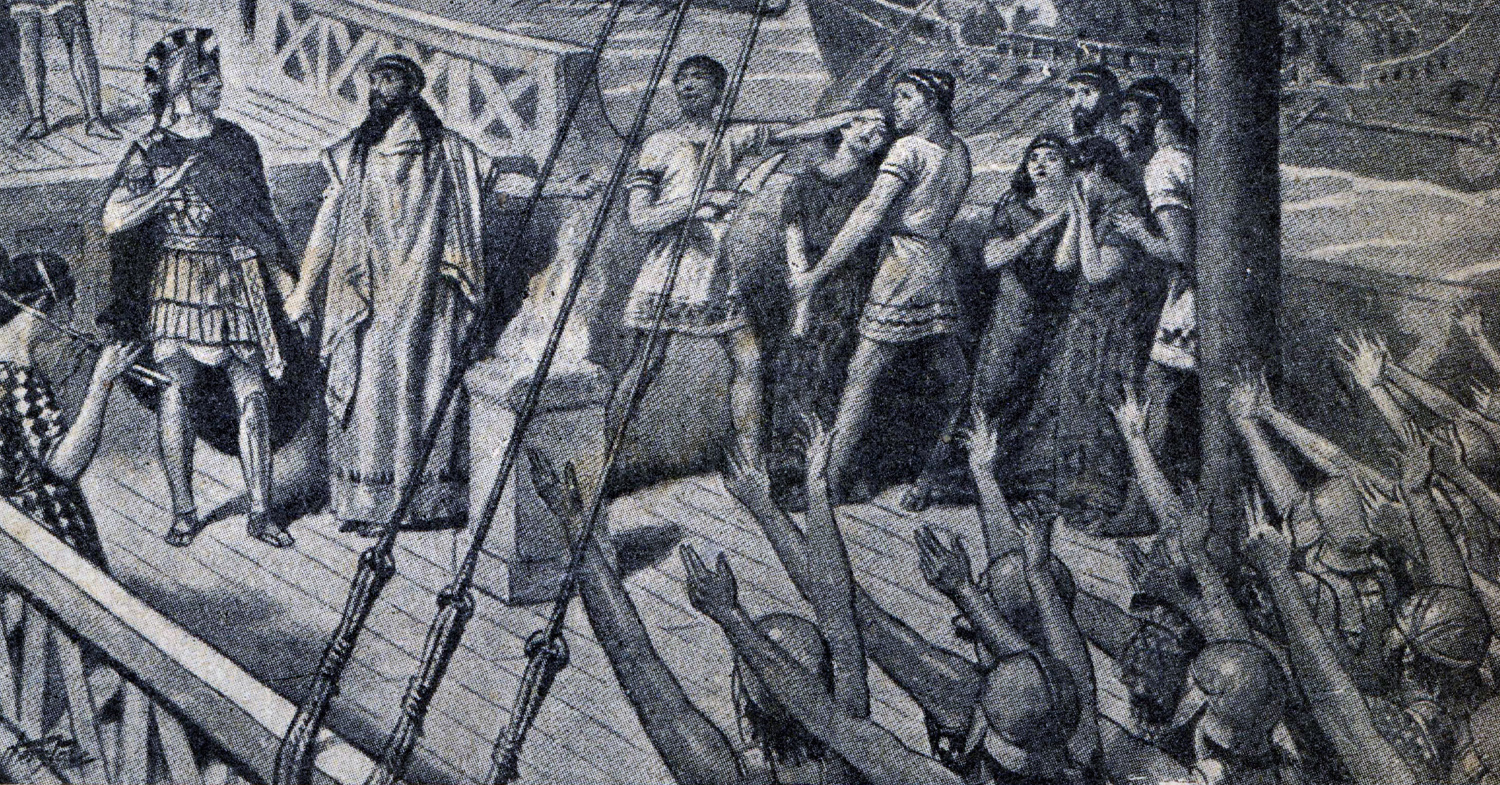
Themistocles Allegedly Conducted A Human Sacrifice Before The Battle of Salamis


Themistocles was an Athenian politician and military strategist who was pivotal in the Greek defeat of the Persian invasion of Greece by Xerxes in 480 BCE. Athens’ great naval strength was in large part due to Themistocles’ influence, as he pushed the Athenians to invest in sea power and to fight Persians in the Aegean. He was the mastermind of the Battle of Salamis, where the Greek coalition navy lured the massive Persian fleet into a narrow strait and delivered a shocking defeat upon Xerxes’ forces. As usually happens, the Greek victory was attributed to sound strategy, stout sailors, and divine aid. Yet, the latter divine component, according to some stories, was gained through unorthodox means. According to legend, Themistocles conducted a human sacrifice in order to cultivate the favor of the gods for his cause.

Plutarch (c. 50-120 CE), the great Greek-Roman biographer, preserved the tale about the human sacrifice of Themistocles in his famous work, the Parallel Lives. He attributed the tale to Phanias of Lesbos (flourished 300 BCE), whom Plutarch described as “a philosopher well read in history” (Life of Themistocles, 13.3).

As the story goes, Themistocles had been preparing an average, human-less, sacrifice in the runup to the Battle of Salamis. A certain prophetic man called Euphrantides, however, had something else in mind to catch the attention of the gods. Central to Euphrantides’ vision was a trio of Persian captives, who presumably came from the upper echelons of society, as they had been wearing elegant clothes and expensive jewelry at the time of their capture. Rumor suggested that the three prisoners were relatives of Xerxes, yet Plutarch admitted that their presumed royal rank was more speculation than proven fact.

When the three Persian prisoners were brought forward, Euphrantides reportedly began crying out for a human sacrifice. He pointed out omens that, according to him, suggested that the gods were eager for the sacrifice to take place. Such omens included the flames of the sacrificial fire rising visibly higher as the Persians neared the altar, and a sneeze—long considered a sign of divine favor or agreement—that rang out from the crowd as the human sacrifice was being discussed. Euphrantides’ mystical charisma, along with the omens that he pointed out, was evidently enough to convince the people to go along with his idea of a human sacrifice.

Themistocles reportedly had some reservations about the sacrifice, but as the people were on Euphrantides’ side, he let the sacrifice commence. Euphrantides was said to have directed the ceremony, but Themistocles or others present had the grisly job of carrying out the sacrifice. The proceedings were mainly catered toward the god Dionysus (or Bacchus), for the prophet claimed that particular deity would be easily swayed by the human sacrifices. Plutarch wrote:

“Themistocles was much disturbed at this strange and terrible prophecy, but the common people, who, in any difficult crisis and great exigency, ever look for relief rather to strange and extravagant than reasonable means, calling up Bacchus with one voice, led the captives to the altar, and compelled the execution of the sacrifice as the prophet had commanded” (Life of Themistocles, 13.3).

It has long been debated whether to categorize the idea of Ancient Greek human sacrifices as legendary or historical. Sporadic descriptions of ancient Greeks conducting human sacrifices can be found in Greek histories and lore, but little archeological evidence has been found to prove the stories true. In 2016, however, the skeleton of a possibly sacrificed ancient Greek individual was found buried at a shrine of Zeus on Mount Lykaion. The skeleton serves as a rare piece of evidence that may back up the legends of ancient Greek human sacrifice. Yet, even so, such sacrifices must have been fairly anomalous in the wider Greek practice of religion.

Written by C. Keith Hansley

Picture Attribution: (Illustration of Themistocles Performing a human sacrifice before the battle of Salamis, created c. 1915, [Public Domain] via Creative Commons).

Sources:
  • Plutarch’s Lives edited by Charles W. Eliot in the Harvard Classics series. New York: P. F. Collier & Son, 1909, 1937.
  • http://penelope.uchicago.edu/Thayer/E/Roman/Texts/Plutarch/Lives/Themistocles*.html 
  • https://www.britannica.com/biography/Themistocles 
  • https://www.britannica.com/event/Battle-of-Salamis 
  • https://www.britannica.com/biography/Xerxes-I  
  • https://www.britannica.com/biography/Phanias 
  • https://www.history.com/news/was-skeleton-unearthed-in-greece-a-human-sacrifice-to-zeus 
  • https://www.smithsonianmag.com/smart-news/did-ancient-greeks-engage-human-sacrifice-180960111/ 
  • https://www.livescience.com/55733-possible-human-sacrifice-to-zeus-discovered.html  

Tuesday, April 30, 2019

The Sacrifice Dilemma At The Battle Of Marathon


By 490 BCE, King Darius I of Persia had brought Ionia, Thrace and Macedonia under his influence and began his presumptive next phase of subjugation by sending an expeditionary force into Euboea. The Persian expeditionary force (estimated to have numbered anywhere from 15,000 to 30,000 troops) crossed over to Attica, where they were intercepted by an army of around 10,000 Athenians and Plataeans on the plains of Marathon. Herodotus claimed that the Greek forces gave sacrifice to the gods before the battle and watched for omens, which, when found, were interpreted as signs of a good outcome. Although not mentioned by Herodotus, Athenian tradition and future historians (such as Xenophon and Plutarch) claimed that one of the religious actions taken by Athens before the Battle of Marathon was a vow to the goddess, Artemis, that, if Greece should prove victorious, they would sacrifice to her a number of animals equal to the number of Persians killed in the battle. When they made this sacred vow, they likely did not know just how big a task they were arranging.

According to Xenophon and Plutarch, Athens promised to sacrifice young goats (kids) to Artemis. Yet, in the scholia to Aristophanes’ The Knights, it was claimed that the Athenians actually promised oxen to the goddess. Whatever the case, promising either goats or oxen, the Greeks charged against the Persians, hoping that their vow of a future sacrifice would bring the gods over to their side. The ensuing Battle of Marathon would become one of the most famous engagements of the ancient world and a key point in the development of a panhellenic Greek identity—it would also, unfortunately, lead to the deaths of untold numbers of livestock.

The Greeks won a major victory at Marathon, and, despite being greatly outnumbered, they reportedly only lost 192 men in the battle. In contrast, Herodotus claimed that 6,400 Persians were killed, which was seemingly calculated on the assumption that a hundred Persians were slain for every three Greek deaths. Although Herodotus gave the Greeks a favorable statistic for the number of Persian dead, many the of historian’s ancient Greek peers apparently believed Herodotus’ account of the Battle of Marathon was maliciously unembellished. For instance, Plutarch wrote in his essay, The Malice of Herodotus, that the statistic of Persian dead should be increased from Herodotus’ claim of 6,400 to one in which “the number of the dead [is] appearing infinite” (section 26).

In any case, whether or not the number of Persian dead was closer to six thousand or infinity, the Athenians owed Artemis an incredible number of sacrificial animals. Although the account from the scholia of Aristophanes claimed the Athenians had originally promised oxen, the story went on to propose that Athens downgraded to goats after they discovered just how many Persians they had killed. Faced with the challenge of rounding up and sacrificing thousands of goats, the Athenians decided to make a pragmatic emendation to their vow with Artemis. Instead of sacrificing the goats in bulk, they made the decision to offer the sacrifices in yearly increments. Writing around a century or more years later, Xenophon (c. 420-350 BCE) commented on the subject, claiming, “They had made a vow to Artemis that they would offer her in sacrifice a goat for every enemy soldier they killed, but they couldn’t find enough goats and so they decided to sacrifice five hundred a year, and they are still carrying out this annual sacrifice” (Anabasis, Book 3, section 2). Most ancient sources agreed with Xenophon that the sacrifices were in increments of 500, but Aelian, in his Various History, claimed that the yearly sacrifices amounted to the favored Greek number of 300.

Written by C. Keith Hansley

Picture Attribution: (Pheidippides giving word of victory at Marathon, painted by Luc-Olivier Merson (1846–1920), [Public Domain] via Creative Commons).

Sources:
  • Anabasis Kyrou (The Expedition/Upcountry March of Cyrus) by Xenophon and translated by Robin Waterfield. New York: Oxford University Press, 2005.
  • http://www.perseus.tufts.edu/hopper/text?doc=Perseus%3Atext%3A2008.01.0352%3Asection%3D26 
  • https://www.britannica.com/event/Battle-of-Marathon 
  • https://www.ancient.eu/marathon/ 
  • https://www.livius.org/articles/battle/marathon-490-bce/the-significance-of-marathon/ 
  • https://www.nationalgeographic.org/thisday/sep12/battle-marathon/ 
  • https://www.history.com/topics/ancient-history/battle-of-marathon  

Monday, February 19, 2018

The Terrible Plague Suffered By Athens In 430 BCE, Amidst The Peloponnesian War


Athens and Sparta, the two most prominent powers in Greece, were already struggling to coexist years before the Greco-Persian Wars ended around 449-448 BCE. After the Greek forces delivered a significant defeat to the Persian Navy at Salamis in 480 BCE, followed quickly by an impressive victory over the Persian army at the Battle of Plataea in 479 BCE, the cities of Athens and Sparta were cemented as proud and prestigious leaders of the Hellenistic world. Gravitating to the powerful states, the cities of Greece divided themselves between leagues led by the two rival powers. Most cities encircling the Aegean Sea aligned themselves with the sea power of Athens, eventually becoming subordinated into an Athenian empire. Similarly, the city-states in the Peloponnesus (with the exception of Argos) banded together under the leadership of mighty Sparta in the Peloponnesian League.

As early as 460 BCE, while the Greco-Persian War was still ongoing, Athens and Sparta began to fight in skirmishes and battles. A peace treaty technically halted the open conflict, but Athens and Sparta continued to undermine each other’s interests in proxy wars between neutral states and league allies. Nevertheless, a full open war between Athens and Sparta was successfully delayed for decades, until 431 BCE, the year in which the Great Peloponnesian War began.

Sparta and its allies declared war on Athens in 431 BCE, claiming that the Athenians had broken the peace treaty by attacking Spartan allies and affiliates. Thebes (on the Spartan side) opened up the conflict by launching a failed attack on Plataea, an ally of Athens. During the first few years of the Peloponnesian War, both sides were sizing each other up, not knowing how to best employ their resources and manpower. In the year 431, the militaries on both sides of the conflict performed relatively poorly. King Archidamus II of Sparta led a Peloponnesian coalition into Athenian-controlled Attica to raid the countryside, while their enemies took shelter behind the walls of Athens. The Peloponnesians stayed in Attica for as long as their supplies could support their army (less than a year), then they simply marched home. In a similar move, the Athenians sent a fleet to raid the Peloponnesian coast. The fleet made gains in some locations, but was repelled in others. Eventually, the ships rerouted to meet up with a huge Athenian army that was raiding near the city of Megara. After reuniting and pillaging the countryside for a time, the Athenians withdrew home to Athens before the year’s end.

In 430 BCE, both sides of the war again prepared for more pillaging and raiding. King Archidamus II led a second army of Peloponnesians into Attica to ravage the countryside, and the Athenians released another fleet to prowl the Peloponnesian coastline. This time, however, the Peloponnesians would have an unexpected biological ally—a plague. According to the Thucydides (c. 460-400 BCE), the plague originated somewhere in Ethiopia and traveled first through Egypt and then through Persia to wreck havoc on the city of Athens. Thucydides, an Athenian military leader and historian, had the displeasure of personally experiencing the deadly plague. He even caught the illness, himself, but thankfully he survived to write his famous text, the History of the Peloponnesian War.

The city of Athens in 430 BCE was exceptionally susceptible to disease. Refugees from vulnerable regions of Attica had poured into Athens, quickly overpopulating the city. The newcomers had to live in huts and shanties that were poorly ventilated and generally unclean. Those who could not live in simple huts found shelter in local temples, but even those sacred spaces would eventually be filled with the dead and dying.

Thucydides described the symptoms of the plague in great detail—to the extent that critics call his account overly dramatic. Nevertheless, his words paint a decent picture of what the Athenian population faced. He wrote that symptoms of the plague first affected the head and, over the course of seven-to-eight days, the effects spread downward through the rest of the body, usually resulting in death. The first signs were red, irritated eyes and a foul-smelling, bleeding mouth and throat. This was combined with sneezing and a rough voice, which could lead to an inability to speak. As the plague spread down into the torso, the patient also suffered from persistent fits of coughing and abdominal pain. The stomach and intestines were also affected, causing vomiting and diarrhea. Other miscellaneous symptoms mentioned by Thucydides included the onset of an insatiable thirst, restless anxiety, insomnia, the appearance of pustules and a painful sensitivity to touch. The plague led to a staggering death toll in Athens—anywhere from 25%-66% of the Athenian population lost their lives to the sickness.

In Thucydides’ opinion, the most tragic observation that he made during the plague was the breakdown of law, order and morality. He wrote that a palpable gloom of morbid and fatalistic emotion descended on Athens. As more and more people thought their death was nigh, they began to take whatever pleasure, wealth or revenge they wanted, regardless of the consequences.

Even though the plague did enormous damage to Athens, the Athenians recovered with enough strength to keep the war going for nearly three decades, and they often appeared to be on the winning side. Nevertheless, after the war had expanded all the way to Sicily, the Athenian navy was finally defeated in several key sea battles, the last being the Battle of Aegospotami in 405 BCE, in which the Spartans captured most of the Athenian fleet. The next year, Athens surrendered to the Peloponnesians.

Written by C. Keith Hansley.

Picture Attribution: (The Plague at Ashdod, by Nicolas Poussin (1594–1665), [Public Domain] via Creative Commons)

Sources:
  • History of the Peloponnesian War (Book II) by Thucydides, translated by Rex Warner and introduced by M. I. Finley. New York: Penguin Classics, 1972. 
  • https://www.britannica.com/event/Peloponnesian-War 
  • https://www.ancient.eu/Peloponnesian_War/ 
  • http://www.history.com/topics/ancient-history/peloponnesian-war 
  • https://www.ancient.eu/Persian_Wars/  

Thursday, November 16, 2017

The Otherworldly Bones Supposedly Belonging To The Ancient Persians Who Fell At The Battle of Plataea


In the region of Plataea, around 479 BCE, the combined forces of the Greek coalition crossed their spears and swords against an army of Persians that was led by Mardonius. The king of Persia, Xerxes I, was already long gone from Greece—he, personally, abandoned the campaign after his disastrous defeat at the naval Battle of Salamis in 480 BCE and decided to leave the administration of the war to his generals. When Xerxes left, he understandably took with him an escort made up of a substantial portion of his invasion army. Yet, the manpower that remained behind with the Persian commander, Mardonius, was still impressive. There is very little certainty as to exactly how many men were present at the Battle of Plataea, but a common statistic is that Mardonius had around 100,000 men and faced an army of approximately 40,000 Greeks. For several days, these two sides maneuvered and fought, with the Greeks eventually emerging with a decisive victory. Mardonius was among the estimated tens-of-thousands of Persians who were slaughtered during the battle. Although conflict continued between Persia and the Greek cities, the Battle of Plataea was an irrecoverable deathblow to the Persian invasion of mainland Greece.

In the aftermath of the battle, the Greek forces captured the Mardonius’ supplies and treasury. In the camp of the Persians, there was an enormous quantity of rich food, gold, silver and artwork, which the Greeks divided among themselves. Yet, also left behind were the remains of thousands of slain Persians. The historian, Herodotus (c. 490-425/420 BCE), wrote that while the various Greek dead were respectfully cared for by their own respective comrades, the Persian corpses from the Battle of Plataea were left to rot.

Herodotus went on to say that Greek treasure hunters, who were scavenging for overlooked valuables, began to notice strange things about the Persian corpses. Odd skeletal remains were found on the battlefield—the Greek observers believed the remains were former Persian soldiers, but some of the discoveries seemed to be anything but human. A peculiar skull and jawbone were supposedly discovered. Herodotus claimed that there were no joins or joints in the different sections of the skull. Similarly, the jaw supposedly did not have individual teeth, but a single, solid horseshoe-shaped mass of tooth material. The ancient historian also claimed that a skeleton was found of a Persian soldier who, when alive, would have stood between seven and eight feet tall.

What exactly these ancient Greek scavengers discovered on the battlefield of Plataea still remains a mystery. Did these ancients misidentify the bones? Did they unearth some sort of fossil? Did an ancient Persian soldier of seven feet in height really die at the Battle of Plataea? Either way, it is a characteristically odd, but interesting, story that you can expect from The Histories of Herodotus.

Written by C. Keith Hansley.

Top picture attribution: (Greek hoplite and Persian warrior fighting each other. Depiction in ancient kylix. 5th c. BCE National Archaeological Museum of Athens, [Public Domain] via Creative Commons).

Sources:
  • From The Histories by Herodotus (Book IX), translated by Aubrey De Sélincourt and revised by John Marincola (Penguin Classics, 2002).  
  • https://www.ancient.eu/Plataea/ 
  • https://www.britannica.com/event/Battle-of-Plataea 

Sunday, November 5, 2017

According To Legend, The Persian King Xerxes The Great Brought Some Uncommon Animals With Him To Greece


Perhaps, it was due to what Xerxes was feeding his livestock, or a sign from the gods, or even more likely, just an embellishment from storytellers and historians. Whatever the reason, odd things kept happening to the animals that Xerxes brought with him on his invasion of Greece.

From around 484-481 BCE, King Xerxes the Great of Persia prepared for his invasion against the Greek city-states. When enough soldiers, equipment, supplies and beasts of burden were all gathered together in a single location, Xerxes set out, around 480 BCE, with his invasion force from Sardis (in the center of western Anatolia) and headed for the Hellespont, now known as the Dardanelles, which links the Aegean Sea to the Sea of Marmara.

While Xerxes was still near Sardis, something bizarre occurred with one of the animals that had been collected for the expedition. According to the dubious sources of the ancient historian, Herodotus (c. 490-425/420 BCE), or possibly just the historian’s own imagination, a mule miraculously gave birth to a foal. This account is miraculous enough as it is—mules are naturally sterile—yet, the foal born from this particular mule was also allegedly a hermaphrodite, with both male and female sexual organs. Herodotus even claimed to have knowledge of which order the genitalia was arranged. He wrote, “There had previously been another portent in Sardis, when a mule dropped a foal with a double set of sexual organs, male and female—the former uppermost” (The Histories, Book 7).

Another miraculous birth from Xerxes’ livestock occurred after he crossed the Hellespont. This outrageous birth involved a pregnant mare. While the previous story about the mule is considered to be impossible, it still fit within the realm of comprehension. This next account, however, does not make any biological sense, at all. Just hear it from Herodotus’ own serious and deadpan tone: “After the whole army had reached the European shore and the forward march had begun, a great portent occurred—a mare gave birth to a hare” (The Histories, Book 7).

The most curious thing about this tale—if there is any grain of truth to it, in the first place—is that Xerxes had no sense of shock to these bizarre events and kept marching further into Greece without a second thought. It makes you wonder how many freakish things were happening with Xerxes’ livestock to make the king not even bat an eye amidst such strange sights.

Written by C. Keith Hansley.


Top picture attribution: ("Lao Thu Thu Tan- Old Rat Taking a Bride", a woodblock print, produced by artisans from the village of Dong Ho in North Vietnam. [Public Domain] via Creative Commons). The picture isn't Greek, but hey, it shows odd animals.

Sources:
  • The Histories by Herodotus, translated by Aubrey de Sélincourt and revised by John Marincola. New York: Penguin Classics, 2002. 

Thursday, November 2, 2017

Did A Mysterious Singing Dust Cloud Foretell The Victory Of The Greeks Over The Persians At The 480 BCE Battle Of Salamis?


For most of 480 BCE, the Persians had a definitive advantage in the Greco-Persian Wars. A huge army led by King Xerxes I (r. 486-465 BCE) crossed the Hellespont, known now as the Dardanelles, from Anatolia into Europe and smashed his way into Attica by overcoming the small band of Greek defenders at Thermopylae. The Persian threat was so absolute that powerful cities, such as Athens, decided to evacuate for more defensible ground.

Not all Greeks, however, were fighting against the Persians. In fact, King Xerxes had a very large contingent of Greek mercenaries. Similarly, groups such as the Macedonians aligned themselves with Persia, or at least played both sides for their own advantage. Persia also took in a number of Greek exiles that were forced to leave their homelands.

Herodotus (c. 490-425/420 BCE), an ancient historian from Halicarnassus, wrote about an odd bit of hearsay from two of these exiles that traveled with the Persian army. In book eight of The Histories, Herodotus claimed that a man named Dicaeus (an Athenian exile) and the exiled King Demaratus of Sparta were traveling through the plain of Thria when they saw a huge dust cloud in the distance. The exiles first thought the tempest was raised by the marching feet of tens-of-thousands of men, but as they kept watching, they saw no sign of humanity within the dust. Adding to the amazing sight, Dicaeus swore he could hear religious songs honoring Dionysus coming from the cloud.

When the stunned Athenian finally raised his eyes from the swirling dust and looked in the direction that the cloud had come from, Dicaeus realized that the strange phenomenon must have originated in Eleusis. That discovery was significant; Eleusis was the seat of arguably the most popular Mystery Religion cult of the ancient world—the cult of the goddesses Demeter and Persephone.

Adding all of these ominous signs together, Dicaeus predicted that the final destination of the moving dust cloud would foretell a major change in the Greco-Persian Wars. If the cloud swept toward the Peloponnesus, then the Greeks were as good as doomed. If, however, the musical storm began to flow toward where the Persian fleet was preparing to attack the Greeks at Salamis, then it would be the Persians who would suffer a terrible loss. While Dicaeus was still making his prophecy, the cloud began to creep in the direction of Salamis.

According to folklore and hearsay recorded by Herodotus, Dicaeus and Demaratus swore not to tell the Persians of their impending doom. Just as had been predicted, the Persian fleet was soundly defeated in 480 BCE by the smaller Greek force at Salamis. It was such a disastrous battle that Xerxes decided to leave the administration of the invasion to his generals so that he could personally return home and save himself from further embarrassment.

Although, Dicaeus and Demaratus allegedly never told their story to any Persians, they apparently loved telling the tale to Greeks. Herodotus, himself, either heard the odd story from the mouth of Dicaeus, or from a second-hand account told by someone who had come in contact with one of the exiles. Of course, this bizarre story should be treated as a tall tale, but nevertheless, it is a fun tidbit of 5th-century BCE storytelling.

Written by C. Keith Hansley

Top picture attribution: (Cropped and edited dust/sand  cloud made by the United States 3rd Marine Aircraft Wing, [Public Domain] via Creative Commons).

Sources:
  • From The Histories by Herodotus (Book VIII), translated by Aubrey De Sélincourt and revised by John Marincola (Penguin Classics, 2002).