Tuesday, December 17, 2019

The Alcohol Exposition Of Rep. Fiorello La Guardia


The date was June 19, 1926, and the United States was struggling through the Prohibition Era (1919/1920-1933), a time in which the U.S. government cracked down on the mass-production and sale of alcoholic beverages. They did this through questionable and ineffective means that produced underwhelming and ironically lawless results.  Although the Temperance Movement and an alliance of dry politicians were in favor of Prohibition, Representative Fiorello La Guardia of New York was in no way a fan. On that June day in 1926, Representative La Guardia decided to express his dissent in a very educational public service announcement that the populace would be sure to drink up—he invited twenty people from the news industry into his Washington D.C. office and then proceeded to demonstrate to them how someone in the United States could use legal store-bought ingredients to make an alcoholic beer.

As the band of newsmen jostled for positions in Fiorello La Guardia’s Congressional office, the representative readied his ingredients. His desk was covered with glass cups and various bottles of different liquids. Like a chemistry teacher, Rep. La Guardia proceeded to hold up one of the bottles for all in the room to see. It was a non-alcoholic (or legally low-alcohol) brew—a product called “near beer.” He took this legal and accessible item and poured its contents into a glass. With that step completed, Rep. La Guardia next showed the reporters another bottle from the table. It was a container of malt extract tonic, another easily-obtainable product that was legal to own during Prohibition. After opening the bottle of extract, Rep. La Guardia raised up the glass with the non-alcoholic beverage already in it, and, upon receiving the full attention of the reporters, he made a show of pouring most of the malt extract into the near beer. After giving the concoction some time to ferment, Rep. La Guardia proclaimed that he had made a 2% beer with simply-procured, legal products. As a final touch, the representative drank the beer and sent the reporters on their way to print reports on his informative stunt.

Representative Fiorello La Guardia received rave reviews from the newspapers that attended his alcohol exposition. Dry politicians, however, balked at the gall of the man and protested. Yet, verbal jabs from his fellow Congressmen did not stop Rep. La Guardia from bringing his brewing show on the road. He was known to have done a second beer production exposition in his home state of New York. Prohibition, however, would not end in the United States until 1933.

Written by C. Keith Hansley

Picture Attribution: (Photograph of Fiorello La Guardia dated between ca. 1915 and ca. 1920, [Public Domain] via the U.S. Library of Congress and Creative Commons).

Sources:
  • http://bioguide.congress.gov/scripts/biodisplay.pl?index=l000007
  • https://www.britannica.com/biography/Fiorello-H-La-Guardia 
  • https://www.pbs.org/kenburns/prohibition/media_detail/2085902822-laguardia/ 
  • https://vinepair.com/articles/la-guardia-homemade-beer/ 
  • https://www.britannica.com/event/Prohibition-United-States-history-1920-1933 
  • https://www.history.com/topics/roaring-twenties/prohibition  

Monday, December 16, 2019

That Time When A Frankish King Politely Asked His People To Not Assassinate Him


King Guntram (r. 561-593) lived at a time when the empire of the Franks was divided between several monarchs of the Merovingian Dynasty. With multiple Merovingian kings vying for primacy in the fractured Frankish sphere of influence, the 6th century was marked by prevalent warfare and intrigue. Such an atmosphere caused Guntram to be concerned and paranoid, and he took precautions to preserve his safety. According to Bishop Gregory of Tours (c. 539-594), King Guntram “never went anywhere without an armed escort. Even when he went to church, or to any other place which he wished to visit, he was always surrounded by a band of guards” (History of the Franks, VII.8). In addition to his armed bodyguards, Guntram reportedly made a public plea, asking for his countrymen to be so kind as to spare him from assassination.

King Guntram was right to be concerned. At least three of his brothers had been murdered—Chramn was burned alive, while King Sigebert and King Chilperic had both been stabbed to death by assassins. Further numbers of Guntram’s uncles and nephews had also been murdered, not to mention the other family members who met less-nefarious violent deaths in battle during the frequent Merovingian civil wars.

Hoping to be one of the few Merovingian males to have a natural death, Guntram ultimately went public with his wish for a peaceful, long life. In 584, not long after the assassination of King Chilperic, a congregation in a church of Paris watched with interest as King Guntram, surrounded by his guards, walked up to the pulpit to deliver a message. According to Gregory of Tours, the king proclaimed, “Men and women, all people present, I ask you to remain loyal to me, instead of assassinating me, as only recently you assassinated my brothers. Give me three years at least in which to bring up these two nephews of mine, who are my adopted sons” (History of the Franks, VII.8). The speech was received well by the public and word of the address spread beyond the city limits of Paris. On the response of the people to the king’s plea, Bishop Gregory of Tours claimed, “the entire population prayed to God for his safety” (History of the Franks, VII.8). King Guntrum’s public address apparently paid off, for, despite the fact that further attempts were indeed made against his life, Guntram continued to rule until his natural death in 592 or 593.

Written by C. Keith Hansley

Picture Attribution: (Miniature from the Bible Historiale, c. 1400-1425, from BL Royal 15 D III, f. 294v, [Public Domain] via picryl.com and Creative Commons).

Sources:
  • The Chronicle of Florence of Worcester translated by Thomas Forester. London: Petter and Galpin, originally published 1854.
  • https://www.britannica.com/biography/Guntram-king-of-Burgundy 
  • https://www.britannica.com/biography/Childebert-II 
  • https://www.britannica.com/biography/Chlotar-II  

Sunday, December 15, 2019

The Costly Treasury Replenishment Of Roman Consuls Titus Romilius And Gaius Veturius


In the first half of the 5th century BCE, the fledgling Roman Republic was constantly harassed by Volscian and Aequian raids. From around 494 to 455 BCE, Roman forces clashed with these marauding raiders on a near-annual basis. Nearby rival city-states of Rome would sometimes join in the Volscian and Aequian raids, making the attacks all the more dangerous and costly, as the Romans were often required to put multiple armies in the field to address threats on different fronts. By 455 BCE, the Roman Republic had apparently depleted its treasury after the decades of constant warfare. Despite Rome’s financial struggles, it was not spared that year in 455 BCE from an all-too-familiar raid—this time the Aequians attacked, threatening Rome and its ally, Tusculum.

Titus Romilius and Gaius Veturius, the Roman consuls of 455 BCE, rallied an army and set off to intercept the Aequians before the invaders did too much damage to Tusculum or to Roman lands. The Roman army found the Aequians at a place called Algidus, located not far from Tusculum, and a great battle reportedly ensued. Livy (c. 59 BCE-17CE), a Roman historian, made an account of the battle in his History of Rome, and from whatever sources he had at his disposal, Livy presented supposed statistics from that engagement.

During the battle at Algidus in 455 BCE, the Romans inflicted a massive defeat upon the Aequians, killing thousands of the invaders. As the defeated Aequians fled the battlefield, they abandoned their camp, leaving behind gear and piles of ill-gained loot. When the Roman consuls, Romilius and Veturius, saw all of this plunder which had been left behind by the defeated foe, the consuls decided to sacrifice personal gain for the good of the bankrupt republic. Livy, describing the battle and its aftermath, wrote, “in the engagement which followed the Aequians were heavily defeated, losing more than 7,000 men and a great deal of material and equipment, all of which the consuls sold, to replenish the depleted treasury” (History of Rome, 3.31). Although the Roman government was happy about the financial relief, the army serving under the consuls were irate that they were not given a cut of the plunder that they had risked their lives to obtain. A grudge developed between consuls and the military over the issue of the plunder, which lasted for the remainder of Romilius’ and Veturius’ terms of office. Unfortunately for the consuls, Rome’s disgruntled warriors were determined to have their revenge, and they would get it after the consuls relinquished their power.

As the story goes, the Roman warriors, and their representatives in government, brought Titus Romilius and Gaius Veturius to court. Livy, the aforementioned Roman historian, did not mention which exact charges were lodged against the former consuls, but he did write that the warriors ultimately won their case, and hefty fines were imposed on Romilius and Veturius. Livy reported the imposed fines based on the value of the Roman ‘as,’ which, in its earliest days was the equivalent of one Roman pound of bronze. The unit was, however, revised in 211 BCE to the sextantal as, which was equated to 1/6 of a Roman pound. Without specifying whether the value was sextantal or whole, Livy reported that Romilius paid 10,000 of the unit, while Veturius paid 15,000. It is unclear if the disgruntled warriors ever received any of the fined wealth, or if the fines simply further lined the state’s treasury.

Written by C. Keith Hansley

Picture Attribution: (Gaius Marius sitting in exile, presumably by Walter Crane (1845–1915), for Mary Macgregor’s Story of Rome, [Public Domain] via Creative Commons).

Sources:
  • The History of Rome by Livy, translated by Aubrey de Sélincourt. New York: Penguin Classics, 2002.
  • http://www.perseus.tufts.edu/hopper/text?doc=Perseus%3Atext%3A1999.02.0145%3Abook%3D3%3Achapter%3D31  

Wednesday, December 11, 2019

One Supposed Way Kavadh I Of Persia Counted His Slain Warriors


From ancient times until the modern day, governments have long prized keeping statistics and catalogs of their resources. In a war-torn age, numbers concerning manpower and military size are especially of interest. Kavadh I (r. 488-496, 498-531), a ruler of Sāsānian Persia, lived in one such age of prevalent warfare and he reportedly took very seriously the task of calculating the number of his warriors who did not return from battle. To aid him in this grim task, Kavadh I reportedly encouraged his military to follow an interesting tradition that resulted in a tangible and visible representation of how many people were lost.

According to the historian Procopius (c. 490-565), Kavadh’s warriors were required to submit a token of sorts to the Sāsānian Persian government before they left on campaign. The historian suggested that these relinquished items were usually small weapons, and if the Persian ruler was present, the warriors would place these tokens in containers set before their leader. Procopius described the alleged ceremony: “the king sits on the royal throne, and many baskets are set there before him; and the general also is present who is expected to lead the army against the enemy; then the army passes along before the king, one man at a time, and each of them throws one weapon into the baskets” (History of the Wars, I.18). After the troops passed by, the many filled baskets were reportedly sealed up, labeled, and placed in a safe location. The baskets (and the tokens locked inside) would not be retrieved until the army returned from its campaign.

As the story goes, once news of an army’s return from battle reached the Persian court, officials would race off to wherever they stored the sealed tokens to retrieve the respective baskets for the homebound army. Then, as Procopius claimed, “when this army returns to Persia, each one of the soldiers takes one weapon out of the baskets. A count is then made by those whose office it is to do so of all the weapons which have not been taken by the men, and they report to the king the number of soldiers who have not returned” (History of the Wars, I.18). Therefore, the unclaimed tokens left in the baskets could be tallied up for a broad number of who was lost in the war from that particular army, be it from death, capture or desertion. Of course, it would be just as easy to write down a head-count of the warriors, themselves, before and after their campaign, or to collect records from the officers who led the forces into battle. Yet, Procopius’ proposed ceremony, if it indeed was put into use, would certainly create a striking visible representation of the human cost of war.

Written by C. Keith Hansley

Picture Attribution: (Convivial meeting of Kai Khosrow by Hossein Qollar-Aqasi, [Public Domain] via Creative Commons).

Sources:
  • History of the Wars by Procopius, translated by H. B. Dewing. Massachusetts: Harvard University Press, 1919.

Tuesday, December 10, 2019

Themistocles Allegedly Conducted A Human Sacrifice Before The Battle of Salamis


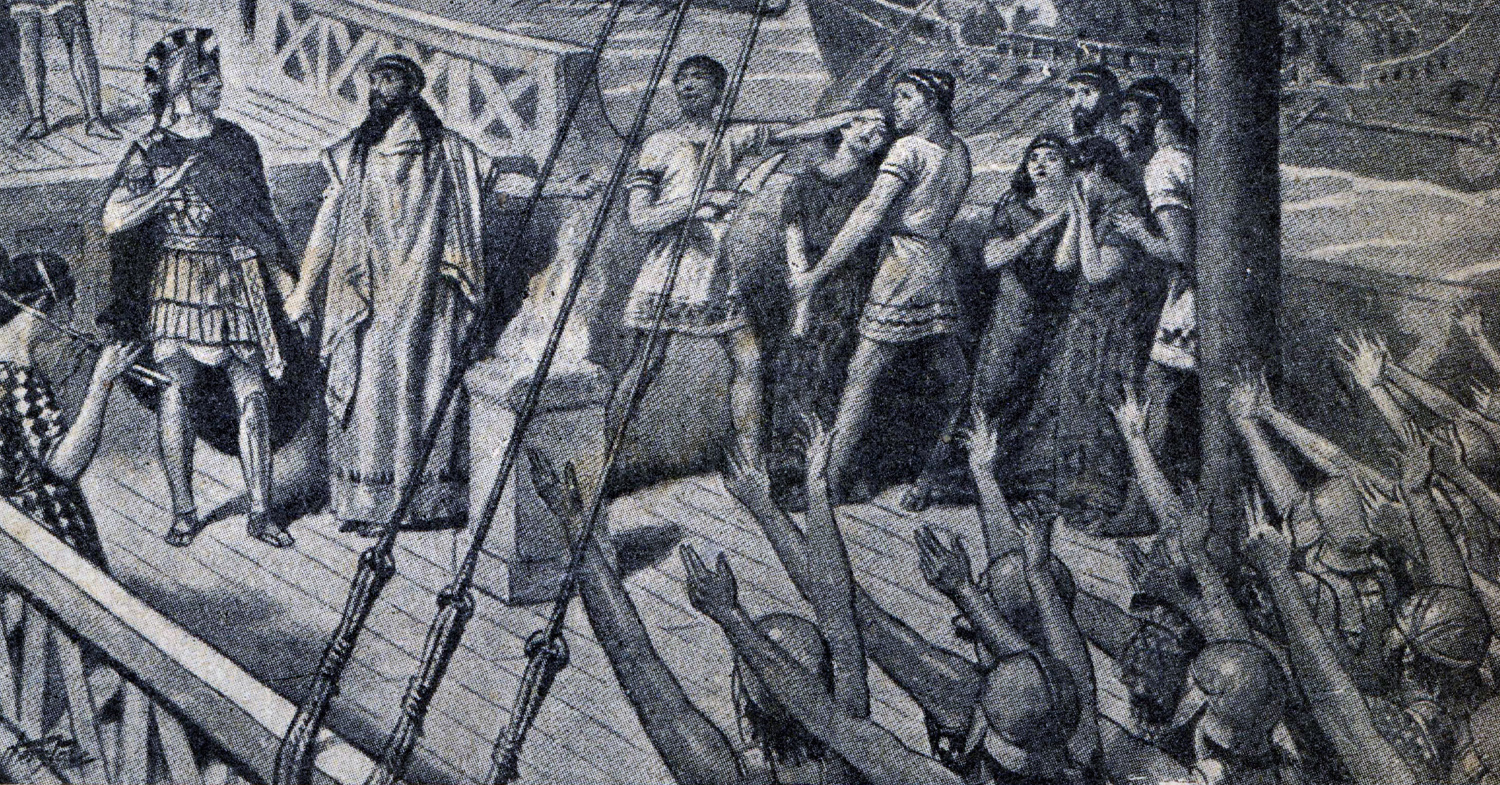
Themistocles was an Athenian politician and military strategist who was pivotal in the Greek defeat of the Persian invasion of Greece by Xerxes in 480 BCE. Athens’ great naval strength was in large part due to Themistocles’ influence, as he pushed the Athenians to invest in sea power and to fight Persians in the Aegean. He was the mastermind of the Battle of Salamis, where the Greek coalition navy lured the massive Persian fleet into a narrow strait and delivered a shocking defeat upon Xerxes’ forces. As usually happens, the Greek victory was attributed to sound strategy, stout sailors, and divine aid. Yet, the latter divine component, according to some stories, was gained through unorthodox means. According to legend, Themistocles conducted a human sacrifice in order to cultivate the favor of the gods for his cause.

Plutarch (c. 50-120 CE), the great Greek-Roman biographer, preserved the tale about the human sacrifice of Themistocles in his famous work, the Parallel Lives. He attributed the tale to Phanias of Lesbos (flourished 300 BCE), whom Plutarch described as “a philosopher well read in history” (Life of Themistocles, 13.3).

As the story goes, Themistocles had been preparing an average, human-less, sacrifice in the runup to the Battle of Salamis. A certain prophetic man called Euphrantides, however, had something else in mind to catch the attention of the gods. Central to Euphrantides’ vision was a trio of Persian captives, who presumably came from the upper echelons of society, as they had been wearing elegant clothes and expensive jewelry at the time of their capture. Rumor suggested that the three prisoners were relatives of Xerxes, yet Plutarch admitted that their presumed royal rank was more speculation than proven fact.

When the three Persian prisoners were brought forward, Euphrantides reportedly began crying out for a human sacrifice. He pointed out omens that, according to him, suggested that the gods were eager for the sacrifice to take place. Such omens included the flames of the sacrificial fire rising visibly higher as the Persians neared the altar, and a sneeze—long considered a sign of divine favor or agreement—that rang out from the crowd as the human sacrifice was being discussed. Euphrantides’ mystical charisma, along with the omens that he pointed out, was evidently enough to convince the people to go along with his idea of a human sacrifice.

Themistocles reportedly had some reservations about the sacrifice, but as the people were on Euphrantides’ side, he let the sacrifice commence. Euphrantides was said to have directed the ceremony, but Themistocles or others present had the grisly job of carrying out the sacrifice. The proceedings were mainly catered toward the god Dionysus (or Bacchus), for the prophet claimed that particular deity would be easily swayed by the human sacrifices. Plutarch wrote:

“Themistocles was much disturbed at this strange and terrible prophecy, but the common people, who, in any difficult crisis and great exigency, ever look for relief rather to strange and extravagant than reasonable means, calling up Bacchus with one voice, led the captives to the altar, and compelled the execution of the sacrifice as the prophet had commanded” (Life of Themistocles, 13.3).

It has long been debated whether to categorize the idea of Ancient Greek human sacrifices as legendary or historical. Sporadic descriptions of ancient Greeks conducting human sacrifices can be found in Greek histories and lore, but little archeological evidence has been found to prove the stories true. In 2016, however, the skeleton of a possibly sacrificed ancient Greek individual was found buried at a shrine of Zeus on Mount Lykaion. The skeleton serves as a rare piece of evidence that may back up the legends of ancient Greek human sacrifice. Yet, even so, such sacrifices must have been fairly anomalous in the wider Greek practice of religion.

Written by C. Keith Hansley

Picture Attribution: (Illustration of Themistocles Performing a human sacrifice before the battle of Salamis, created c. 1915, [Public Domain] via Creative Commons).

Sources:
  • Plutarch’s Lives edited by Charles W. Eliot in the Harvard Classics series. New York: P. F. Collier & Son, 1909, 1937.
  • http://penelope.uchicago.edu/Thayer/E/Roman/Texts/Plutarch/Lives/Themistocles*.html 
  • https://www.britannica.com/biography/Themistocles 
  • https://www.britannica.com/event/Battle-of-Salamis 
  • https://www.britannica.com/biography/Xerxes-I  
  • https://www.britannica.com/biography/Phanias 
  • https://www.history.com/news/was-skeleton-unearthed-in-greece-a-human-sacrifice-to-zeus 
  • https://www.smithsonianmag.com/smart-news/did-ancient-greeks-engage-human-sacrifice-180960111/ 
  • https://www.livescience.com/55733-possible-human-sacrifice-to-zeus-discovered.html  

Monday, December 9, 2019

Halphas Or Malthus—A Demon Of Construction, Logistics, And Requisition


According to occultists and demonologists, Halphas (also known as Malthus) is a spirit who has powers quite unique from his supernatural comrades. Halphas appears in the Shemhaphorash of the Lemegeton (or the Lesser Key of Solomon), a peculiar renaissance-age text which purports to list seventy-two demons or spirits which, according to legend, were summoned and controlled by the biblical King Solomon. Halphus is the thirty-eighth spiritual being named in the text’s list, and is described as preferring to take the shape of a dove, but can transform into human form and speak with a hoarse voice. Unlike most of the other spiritual beings listed in the text, poor Halphas was said to have virtually no offensive capabilities in his demonic repertoire. Whereas his brethren could supposedly do such flashy things as smite cities, spread disease, and cause lightning storms and rogue waves, Halphas instead reportedly specializes in more mundane abilities.

As stated earlier, Halphas supposedly can transform into a dove, and this may be judged as one of his most stylish abilities. Using this form, Halphas can get a lay of the land and set the blueprints for his next talent—construction. Using either magic or supernatural knowledge, this demon knows how to build one hell of a tower. But wait, there’s more: Halphas’ job description says he will not only build the tower, but also do the requisition work to stock the new defensive feature with weaponry and ammunition. If that were not enough, this peculiar demon can also serve in the role of a recruiter and strategist, garrisoning the newly built tower with warriors and sending them where they need to go. So, instead of all the pieces being sold separately, Halphas apparently offers a bundled deal. For those who wish to read the original description of Halphas’ peculiar abilities in the original grimoire tone, the Lemegeton stated: “His Office is to build up Towers, and to furnish them with Ammunition and Weapons, and to send Men-of-War to places appointed” (Lemegeton, Shemhaphorash, #38).

Despite Halphas’ fairly undemonic and mundane abilities, his skills in architecture, requisition and logistics have apparently gained him an admirable following in the spiritual world. He supposedly rules over twenty-six legions of lesser spirits and is considered a nobleman with the rank of earl in the demonic hierarchy.

Written by C. Keith Hansley

Picture Attribution: (Sketch of a Gargoyle in Paris, by Charles Meryon c. 1853, [Public Domain] via Creative Commons).

Sources:
  • The Three Magical Books of Solomon by Crowley, Mathers and Conybear. Vega Publishing, 2019 (original publications c. 1888, 1898, 1904.
  • https://www.sacred-texts.com/grim/lks/lks05.htm#fr_20  

Sunday, December 8, 2019

The Comical Tale About The Ugly Feet Of Thórarin Nefjólfsson


A prominent Icelandic merchant named Thórarin Nefjólfsson happened to be in Túnsberg (now Tønsberg), Norway, at a time when King Olaf II Haraldsson (r. 1015-1028) was residing in the city. Thórarin reportedly was an intelligent, eloquent and candid individual. Yet, unfortunately for the Icelander, he was best known for another quality—ugliness. The Icelandic historian Snorri Sturluson (1179-1241) colorfully claimed, “Thórarin was exceedingly ugly, and particularly his limbs. He had big and misshapen hands, but his feet were uglier even by far” (Heimskringla, Saint Olaf’s Saga, chapter 85). Thórarin Nefjólfsson, for his part, embraced his own ugliness, and was the kind of person who enjoyed poking fun at his own features. Due to his endearing nature, his wealth, and his prominence, Thórarin was invited by King Olaf II to stay with the royal party for a time. The Icelander reportedly even had the honor of sleeping in the same hall as the king, along with other people that the monarch trusted.

As the story goes, one morning while King Olaf II was lying awake in his bed, not yet willing to get up, the king procrastinated by observing the bunks of the people around him, and in doing so, Olaf caught sight of something he thought to be truly grotesque. As the other occupants of the room began to stir, the king directed their attention to the horrific sight, and they all agreed it was one of the worst visual experiences they had ever witnessed. What had caught their attention, of course, was their Icelandic guest, specifically the sight of a single bare foot belonging to Thórarin Nefjolfsson that had popped out from the man’s bed covers during the night. According to Snorri Sturluson, King Olaf mused aloud to his comrades, “I have been awake for a while, and I have seen a sight which seems to me worth seeing, and that is, a man’s foot so ugly that I don’t think there is an uglier one here in this town” (Heimskringla, Saint Olaf’s Saga, chapter 85).

Thórarin Nefjolfsson soon woke up and realized that everyone in the hall was staring at his foot. King Olaf, with the boldness of a king, and the knowledge that Thórarin was a good sport about his appearance, spoke plainly to the Icelandic merchant and explained that they were all amazed by the ugliness of the man’s foot. Furthermore, according to Snorri Sturluson, King Olaf went on to proclaim, “I rather warrant you that there isn’t an equally ugly foot to be found, and I would even be willing to bet on that” (Heimskringla, Saint Olaf’s Saga, chapter 85). Hearing this assertion, Thórarin Nefjolfsson took the king up on his bet, and the two set their stakes for the wager. Thórarin Nefjolfsson, if he won, wanted to be officially invited into the king’s retinue, while Olaf’s request was for the Icelander to do a royal errand. With the bets set, Thórarin began planning how to find an uglier foot in the city of Túnsberg.

As the story goes, Thórarin Nefjólfsson did not have to look far for his answer. He did not have to leave the hall, nor even his bunk, for the winning exhibit. With a triumphant flourish, Thórarin popped out his other foot from under the bed covers and displayed it for all to see. His second foot was just as ugly as the first, yet the big toe on this newer foot had been amputated for some reason or other, causing it to be all the more ghastly.

Olaf II was on the verge of losing his bet, and everybody knew it, so the king had to think up a witty response to bring the wager back into his favor. After assessing the Icelander’s second foot, the king proclaimed that the amputated toe was a mercy, as there was one less horrendous digit to look at. According to Snorri Sturluson, the king further explained his reasoning by saying “The first foot is uglier because there are five toes on it, whilst this one has only four” (Heimskringla, Saint Olaf’s Saga, chapter 85). Thórarin Nefjólfsson did not dispute Olaf’s math and conceded victory to the king. Ultimately, however, both participants in the bet received what they wanted. The Icelander was named a member of King Olaf’s retinue, and Thórarin Nefjólsson completed an errand for the king by transporting an exiled Norwegian to Iceland.

Written by C. Keith Hansley.

Picture Attribution: (Scene of Thorarin Nefjolfsson and King Olaf II illustrated by Christian Krohg (1852–1925), [Public Domain] via Creative Commons).

Sources:
  • Heimskringla, by Snorri Sturluson and translated by Lee Hollander. Austin: University of Texas Press, 1964, 2018.