Showing posts with label Religion. Show all posts

Tuesday, January 28, 2020

Zeus’ Punishment For Oath-breaking Gods And Goddesses, According To Hesiod


After the Olympian gods toppled the regime of the Titan Kronos and accepted lightning-wielding Zeus as the new leader of the Greek divine world, the victorious deities convened to set up new rules and procedures for their reign. One of the important ceremonies that they developed was the ability to make oaths. The guardian and enforcer of these promises was the goddess, Styx, who personified and sustained the famous underworld river that shared her name. When the gods made oaths or were questioned for facts, the deities reportedly swore to tell the truth over a cup or jug of Styx’ water, which Zeus had on hand or fetched for such occasions. Telling lies or breaking oaths after making a vow over the waters of Styx reportedly had dire consequences in itself, but Zeus amplified the punishment with his own personal touch after the Styx water’s effects wore off.

According to the Theogony of Hesiod, if a god or goddess of Olympus lied or broke an oath after swearing not to do so over the water of Styx, the guilty deity would suddenly stop breathing and fall into some sort of coma. Motionless and speechless, the stricken god or goddess was then simply left on a bed, and the other deities of the community kept their distance, not even bringing the ill creature ambrosia or nectar for strength. The oath-breaking or lying god or goddess would remain comatose and ambrosia deprived for a year, at which time they would wake from their slumber. Yet, the punishment was just beginning. Zeus, upon hearing the coma had ended, would then sentence the oath-breaker to nine full years of exclusion or banishment. During that time, the ostracized god or goddess could not participate in any divine councils, nor attend any feasts or parties held by Zeus and the other Olympian gods. Only after serving the full nine-year term of exclusion would the punishment end, and the oath-breaker would finally be allowed to rejoin the community of gods when the long-awaited tenth year arrived.

Written by C. Keith Hansley

Picture Attribution: (The Council of Gods, painted by Raphael  (1483–1520), [Public Domain] via Creative Commons).

Sources:
  • Theogony and Works and Days by Hesiod, translated by M. L. West. Oxford: Oxford University Press, 1988, 1999, 2008.
  • https://www.theoi.com/Khthonios/PotamosStyx.html  

Monday, January 13, 2020

The Murder Of Moneylender Armentarius


Armentarius was a moneylender who operated in the late 6th century. As a man of the Jewish religion, he was able to work around the medieval Christian stigma against usury, and could lend money, buy government bonds, and charge interest on his loans. Yet, his benefit of being able to receive interest payments came at great risk, especially as Armentarius’ clients could often be at the top of society, with leading nobles and their assistants making up much of his business.  If he pushed too hard for his loan payoff, or if his clients became distressed because of debts, Armentarius could easily find himself in peril. Armentarius had to manage these touchy relationships himself, for the kings and courts of public opinion in medieval Europe were becoming more and more tainted with antisemitism, allowing for angry debtors to fight back against moneylenders by stoking bias, bigotry and the us-versus-them mentality. Despite the dangers, Armentarius continued lending money and the governing nobles and officials continued to be his targeted audience.

In 584, Armentarius arrived in Tours, hoping to collect money that he was owed by Count Eunomius and Vice-Count Injuriosus. The moneylender knew that his mission was potentially dangerous, so he brought two Christian protectors along with him to Tours, and a fellow Jewish friend also joined the party.  Armentarius and his three companions, upon entering Tours, had a meeting with Count Eunomius and Vice-Count Injuriosus, in which the moneylender was assured that his loans would be reimbursed with interest. After the meeting concluded, Injuriosus invited Armentarius and his associates to his nearby estate in Tours, where they could further discuss payment options over dinner. Injuriosus also promised to provide his guests with lodgings on or near his own property.

Injuriosus, keeping his word, held a feast for the moneylender’s party and, when night began to fall, the vice-count had his servants lead the guests toward their promised lodgings. Yet, all was not as it seemed. Injuriosus had ulterior motives for luring Armentarius onto his estate, and the servants that he had leading the guests were not simple butlers. According to Gregory of Tours, the bishop of the city at the time of these events, “the Jews and the two Christians were killed by the servants of Injuriosus and their bodies were thrown into a well which was near the house” (History of the Franks, VII.23).

The murder of Armentarius and his companions did not go unnoticed, but it was outside influence that finally prompted an investigation and trial. Family and friends of Armentarius became concerned when their loved one disappeared. They retraced his steps to Tours and scoured the city for news of what happened. After some admirable sleuthing, they successfully found the well near Vice-Count Injuriosus’ house and recovered the remains of the four people that had been thrown down into the depths. Citing local hearsay, the suspicious location of the body dumping site, and the large debts that the vice-count owed Armentarius, the family and friends of the moneylender brought their case before the local justice system. Injuriosus, however, had friends and clout in the court, and he assumed a simple defense of swearing that he had not been involved in the murders. Bishop and historian Gregory of Tours reported on this lackluster trial, writing, “He was prosecuted: but, as I have said, he denied his guilt vehemently, and the plaintiffs had no evidence on which he could be convicted. He was sentenced to clear himself by oath” (History of the Franks, VII.23). After this disappointing result, Armentarius’ family reportedly followed up by bringing their case directly to King Childebert II of the Franks (r. 575-595). The king and his court ignored the case, however, and no further trials of Vice-Count Injuriosus were held concerning the murder of Armentarius and his associates.

Written by C. Keith Hansley

Picture Attribution: (Scene from Frankish History of Duke Guntram Boso being ambushed on the road, painted by Lawrence Alma-Tadema  (1836–1912), [Public Domain] via Creative Commons).

Sources:
  • The History of the Franks by Gregory of Tours, translated by Lewis Thorpe. New York: Penguin Classics, 1971.

Sunday, January 12, 2020

According To Hesiod, The Love-God Eros Was One Of The Oldest Divine Beings


In his epic poem, Theogony, the 8th-century BCE Greek poet, Hesiod, strove not only to tell myths about the gods, but to also trace the lineages and genealogy of the divine beings.  In the beginning, claimed Hesiod, there existed a great Chasm from which sprang the primordial deities. The first personified entity that emerged from the Chasm was Gaia (Earth). Similarly, Nyx (Night) and the less-personified Erebos (a realm of darkness) also appeared out of the Chasm. This small cast of Chasm-spawned deities might have been the only gods that the ancient Greek world would have known had not one more being flown out of the Chasm to prod the shy primordial deities into the act of procreation. To fulfill this purpose, the mysterious Chasm created Eros, who brought feelings of attraction and love to the divine world—emotions that would forever change the Greek gods and humanity.

Upon the arrival of this erotic deity and his powerful aphrodisiac side effects, the primordial gods inevitably began to feel quite interested in each other.  There was no fighting his influence as, according to Hesiod, Eros was “the dissolver of flesh, who overcomes the reason and purpose in the breasts of all gods and all men” (Theogony, line 120). After falling prey to Eros’ machinations, the gods Nyx and Erebos hooked up to have children. Gaia, too, felt the mood enough to create her own lover, Ouranos (Heaven). Gaia and Ouranos would in turn bring about the Titans, among which the couple of Kronos and Rhea would become the parents to most of the Olympian gods. In turn, the Olympian pantheon, led by ever-lusty Zeus, who would go on to create more gods, demigods and mythical creatures—so on and so forth, all thanks to the power of primordial Eros.

Written by C. Keith Hansley

Picture Attribution: (4th century BCE image of Eros on pottery exhibited in the Blanton Museum of Art - Austin, Texas, USA, [Public Domain] via Creative Commons).

Sources:
  • Theogony and Works and Days by Hesiod, translated by M. L. West. Oxford: Oxford University Press, 1988, 1999, 2008.
  • http://www.perseus.tufts.edu/hopper/text?doc=Perseus%3Atext%3A1999.01.0130%3Acard%3D104 
  • https://www.theoi.com/Protogenos/Eros.html 
  • https://www.theoi.com/Ouranios/Eros.html

Tuesday, January 7, 2020

Zeus Gained His Power Over Lightning From Thankful Cyclopes


New generations overthrowing the old was a repeated theme in ancient Greek mythology. The first ruling couple of ancient Greek myth was Gaia (Earth) and Ouranos (Heaven). To this pair was born the Titans, the Cyclopes and the Hecatoncheires (Hundred-Handed Ones). The last two of these groups were so powerful that Ouranos had them imprisoned in the earth out of fear, doing so without Gaia’s permission or consent. As payback for the imprisonment of her sons and other abuses, Gaia plotted with the Titans and helped them successfully removed Ouranos from power by giving the arch-Titan, Kronos, a sickle that he used to emasculate his father. Once in power, however, Kronos did not release the Cyclopes or the Hecatoncheires. Also—like father like son—when Kronos began having children with his fellow Titan, Rhea, he feared his offspring’s power so much that he, too, wanted them imprisoned. Instead of locking them inside the earth, Kronos swallowed the newborn godlings, who happened to be many of the main members of the future Olympian pantheon.

Rhea, like Gaia before her, did not appreciate what was happening to her children, and it was when she was about to give birth to baby Zeus that she finally had enough. She swaddled a rock in baby clothing and handed the stone over to Kronos, who promptly ate it without any investigation. Meanwhile, Rhea slipped off to sympathetic Gaia, and they arranged for little Zeus to be raised secretly in Crete. Once Zeus came of age, he began building a coalition to take down his father. At this point, however, Zeus was apparently only godly in terms of strength, with little-to-no divine smiting ability, so the fledgling god’s first steps were taken in the form of espionage and sabotage. He successfully arranged for a substance to be fed to Kronos which resulted in the Titan regurgitating all of the children of Rhea that he had eaten. For his next step, Zeus tracked down his long-imprisoned uncles, the Cyclopes and the Hecatoncheires. These beings Zeus freed from their prisons in exchange for promises of help in the upcoming confrontation between the Olympian gods and the Titans.

The hundred-handed Hecatoncheires may have been unsurpassed warriors, but it was the Cyclopes that gave Zeus his particularly iconic advantage. According to the ancient Greek poet Hesiod, the thankful Cyclopes were the ones who “gave Zeus his thunder and forged his thunderbolt” (Theogony, lines 139-145). With his Olympian siblings freed, the recruitment of the monstrous Hecatoncheires, and the acquisition of his famous Cyclopes-forged lightning weaponry, Zeus was able to topple Kronos and supplant the Titans in a ten-year mythological conflict known as the Titanomachy.

Written by C. Keith Hansley

Picture Attribution: (Athena/Minerva, Zeus/Jupiter and other gods, painted by René-Antoine Houasse (1645–1710), [Public Domain] via Creative Commons).

Sources:
  • Theogony and Works and Days by Hesiod, translated by M. L. West. Oxford: Oxford University Press, 1988, 1999, 2008.
  • https://www.theoi.com/Protogenos/Ouranos.html 
  • https://www.theoi.com/Titan/Hekatonkheires.html 
  • https://www.theoi.com/Titan/Titanes.html#Titanomakhia 
  • https://www.theoi.com/Titan/TitanisRhea.html  
  • https://www.theoi.com/Olympios/Zeus.html  

Tuesday, December 10, 2019

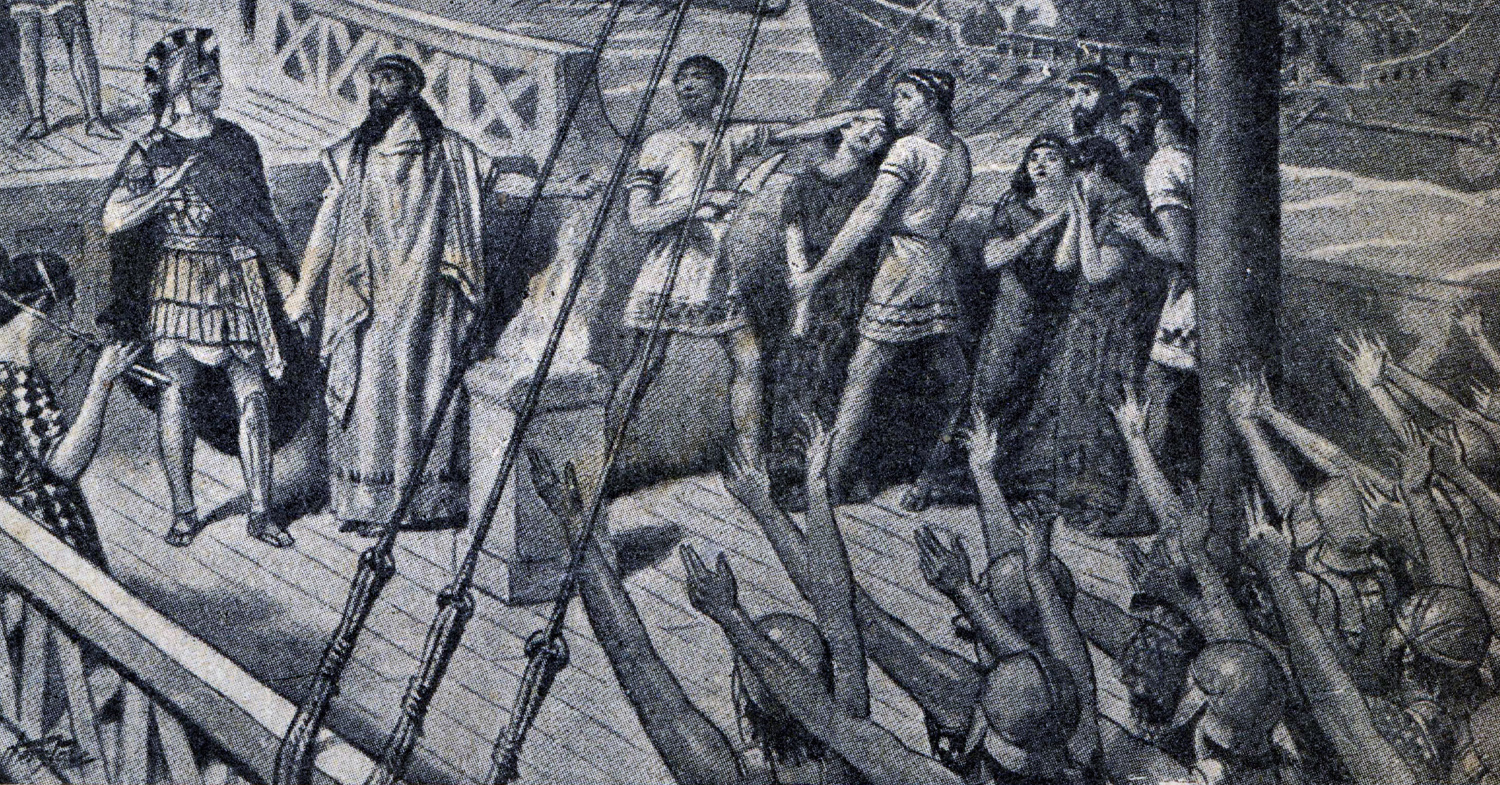
Themistocles Allegedly Conducted A Human Sacrifice Before The Battle of Salamis


Themistocles was an Athenian politician and military strategist who was pivotal in the Greek defeat of the Persian invasion of Greece by Xerxes in 480 BCE. Athens’ great naval strength was in large part due to Themistocles’ influence, as he pushed the Athenians to invest in sea power and to fight Persians in the Aegean. He was the mastermind of the Battle of Salamis, where the Greek coalition navy lured the massive Persian fleet into a narrow strait and delivered a shocking defeat upon Xerxes’ forces. As usually happens, the Greek victory was attributed to sound strategy, stout sailors, and divine aid. Yet, the latter divine component, according to some stories, was gained through unorthodox means. According to legend, Themistocles conducted a human sacrifice in order to cultivate the favor of the gods for his cause.

Plutarch (c. 50-120 CE), the great Greek-Roman biographer, preserved the tale about the human sacrifice of Themistocles in his famous work, the Parallel Lives. He attributed the tale to Phanias of Lesbos (flourished 300 BCE), whom Plutarch described as “a philosopher well read in history” (Life of Themistocles, 13.3).

As the story goes, Themistocles had been preparing an average, human-less, sacrifice in the runup to the Battle of Salamis. A certain prophetic man called Euphrantides, however, had something else in mind to catch the attention of the gods. Central to Euphrantides’ vision was a trio of Persian captives, who presumably came from the upper echelons of society, as they had been wearing elegant clothes and expensive jewelry at the time of their capture. Rumor suggested that the three prisoners were relatives of Xerxes, yet Plutarch admitted that their presumed royal rank was more speculation than proven fact.

When the three Persian prisoners were brought forward, Euphrantides reportedly began crying out for a human sacrifice. He pointed out omens that, according to him, suggested that the gods were eager for the sacrifice to take place. Such omens included the flames of the sacrificial fire rising visibly higher as the Persians neared the altar, and a sneeze—long considered a sign of divine favor or agreement—that rang out from the crowd as the human sacrifice was being discussed. Euphrantides’ mystical charisma, along with the omens that he pointed out, was evidently enough to convince the people to go along with his idea of a human sacrifice.

Themistocles reportedly had some reservations about the sacrifice, but as the people were on Euphrantides’ side, he let the sacrifice commence. Euphrantides was said to have directed the ceremony, but Themistocles or others present had the grisly job of carrying out the sacrifice. The proceedings were mainly catered toward the god Dionysus (or Bacchus), for the prophet claimed that particular deity would be easily swayed by the human sacrifices. Plutarch wrote:

“Themistocles was much disturbed at this strange and terrible prophecy, but the common people, who, in any difficult crisis and great exigency, ever look for relief rather to strange and extravagant than reasonable means, calling up Bacchus with one voice, led the captives to the altar, and compelled the execution of the sacrifice as the prophet had commanded” (Life of Themistocles, 13.3).

It has long been debated whether to categorize the idea of Ancient Greek human sacrifices as legendary or historical. Sporadic descriptions of ancient Greeks conducting human sacrifices can be found in Greek histories and lore, but little archeological evidence has been found to prove the stories true. In 2016, however, the skeleton of a possibly sacrificed ancient Greek individual was found buried at a shrine of Zeus on Mount Lykaion. The skeleton serves as a rare piece of evidence that may back up the legends of ancient Greek human sacrifice. Yet, even so, such sacrifices must have been fairly anomalous in the wider Greek practice of religion.

Written by C. Keith Hansley

Picture Attribution: (Illustration of Themistocles Performing a human sacrifice before the battle of Salamis, created c. 1915, [Public Domain] via Creative Commons).

Sources:
  • Plutarch’s Lives edited by Charles W. Eliot in the Harvard Classics series. New York: P. F. Collier & Son, 1909, 1937.
  • http://penelope.uchicago.edu/Thayer/E/Roman/Texts/Plutarch/Lives/Themistocles*.html 
  • https://www.britannica.com/biography/Themistocles 
  • https://www.britannica.com/event/Battle-of-Salamis 
  • https://www.britannica.com/biography/Xerxes-I  
  • https://www.britannica.com/biography/Phanias 
  • https://www.history.com/news/was-skeleton-unearthed-in-greece-a-human-sacrifice-to-zeus 
  • https://www.smithsonianmag.com/smart-news/did-ancient-greeks-engage-human-sacrifice-180960111/ 
  • https://www.livescience.com/55733-possible-human-sacrifice-to-zeus-discovered.html  

Monday, December 9, 2019

Halphas Or Malthus—A Demon Of Construction, Logistics, And Requisition


According to occultists and demonologists, Halphas (also known as Malthus) is a spirit who has powers quite unique from his supernatural comrades. Halphas appears in the Shemhaphorash of the Lemegeton (or the Lesser Key of Solomon), a peculiar renaissance-age text which purports to list seventy-two demons or spirits which, according to legend, were summoned and controlled by the biblical King Solomon. Halphus is the thirty-eighth spiritual being named in the text’s list, and is described as preferring to take the shape of a dove, but can transform into human form and speak with a hoarse voice. Unlike most of the other spiritual beings listed in the text, poor Halphas was said to have virtually no offensive capabilities in his demonic repertoire. Whereas his brethren could supposedly do such flashy things as smite cities, spread disease, and cause lightning storms and rogue waves, Halphas instead reportedly specializes in more mundane abilities.

As stated earlier, Halphas supposedly can transform into a dove, and this may be judged as one of his most stylish abilities. Using this form, Halphas can get a lay of the land and set the blueprints for his next talent—construction. Using either magic or supernatural knowledge, this demon knows how to build one hell of a tower. But wait, there’s more: Halphas’ job description says he will not only build the tower, but also do the requisition work to stock the new defensive feature with weaponry and ammunition. If that were not enough, this peculiar demon can also serve in the role of a recruiter and strategist, garrisoning the newly built tower with warriors and sending them where they need to go. So, instead of all the pieces being sold separately, Halphas apparently offers a bundled deal. For those who wish to read the original description of Halphas’ peculiar abilities in the original grimoire tone, the Lemegeton stated: “His Office is to build up Towers, and to furnish them with Ammunition and Weapons, and to send Men-of-War to places appointed” (Lemegeton, Shemhaphorash, #38).

Despite Halphas’ fairly undemonic and mundane abilities, his skills in architecture, requisition and logistics have apparently gained him an admirable following in the spiritual world. He supposedly rules over twenty-six legions of lesser spirits and is considered a nobleman with the rank of earl in the demonic hierarchy.

Written by C. Keith Hansley

Picture Attribution: (Sketch of a Gargoyle in Paris, by Charles Meryon c. 1853, [Public Domain] via Creative Commons).

Sources:
  • The Three Magical Books of Solomon by Crowley, Mathers and Conybear. Vega Publishing, 2019 (original publications c. 1888, 1898, 1904.
  • https://www.sacred-texts.com/grim/lks/lks05.htm#fr_20  

Wednesday, December 4, 2019

Margery Kempe And Her Close Encounter With A Falling Beam


By 1413, Margery Kempe—an up-and-coming mystic and self-proclaimed holy woman—was dividing the masses of England down lines of public opinion. Although she could not read, she apparently memorized much of the Bible through hearing, and she claimed to have had personal access to holy wisdom through vivid visions in which she saw and conversed with Jesus. Margery’s spiritualism pushed her in some unique directions; she became a vegetarian after a vision in 1409, then cajoled her husband into joining her in a vow of chastity by 1413, and, in her greatest calling-card, she became prone to profuse sobbing during religious services. Such antics made Margery one of those figures that people could only love or hate.

Around June 1413, Margery Kempe was concerned about her already divided reputation. As she dictated to a scribe in her autobiography, Margery Kempe, at that time, was “very much fearing public opinion, which said God should take vengeance upon her” (Book of Margery Kempe, Book I, chapter 9). To console her fears, Margery Kempe went to church in her hometown of King’s Lynn to pray, hoping for some divine aid in her ongoing struggle with public relations. Yet, ironically enough, what would occur that day in church would in no way bring her supporters and decriers together. Instead, what would befall her in the church would be seen by both her fans and critics as proof for their positive and negative opinions.

On that June day in 1413, Margery Kempe entered the church and lowered herself in prayer, calling up to the heavens for aid and strength. She quickly had an answer to her prayers, and other parishioners in the church did not need a mystic’s mind to hear God’s loud and clear response. Loud creaks and cracks echoed out in the sanctuary, and Margery Kempe described what happened next (in the third person) within her autobiography:

 “Suddenly—from the highest part of the church vault, from under the base of the rafter—there fell down on her head and on her back a stone which weighed three pounds, and a short end of a beam weighing six pounds, so that she thought her back was broken in pieces, and she was afraid that she would be dead in a little while. Soon after she cried, ‘Jesus, mercy,’ and immediately her pain was gone” (Book of Margery Kempe, Book I, chapter 9).

As this was a very public and eye-catching event, news about Margery Kempe’s close encounter with the falling rock and beam from her very church spread fast. Her supporters proclaimed that it was a miracle—God had shielded her from pain and harm, and she walked away from the incident unscathed. Yet, her detractors instead proclaimed that the falling rock and beam were a warning from God, and a sign that her actions were not looked upon favorably from heaven. As Margery herself mused, “many people greatly glorified God in this creature [Margery]. And also many people would not believe it, but preferred to believe it was more a token of wrath and vengeance than of mercy or favor” (Book of Margery Kempe, Book I, chapter 9).

Written by C. Keith Hansley

Picture Attribution: (Detail of a miniature (dated c. 1320-1340) of an allegorical figure embodying Tristesse (Sadness). Image taken from f. 10 of Roman de la Rose (index Romance of the Rose), [Public Domain] via picryl.com and Creative Commons).

Sources:
  • The Book of Margery Kempe, dictated by Margery Kempe, and translated to modern English by B. A. Windeatt. New York, Penguin Classics, 2000.

Monday, December 2, 2019

Saint-King Olaf II And His Victory Over The 5-King Conspiracy


In 1015, Olaf Haraldsson launched his bid for the throne of Norway, killing, exiling, or otherwise forcing into submission the regional jarls who were beholden to other kings of Scandinavia. By 1016, he had brought Norway under his control, becoming King Olaf II, but there were still pockets of resistance among the jarls, petty kings, and chieftains who were uneasy with their new king. Around 1017, King Olaf (also known as Saint Olaf) dramatically clashed with several of these wavering noblemen who did not agree with his efforts to spread Christianity in their domains. The ensuing showdown was recorded in verse by an 11th-century Icelandic skald named Ottar the Black, whose poem was cited by Snorri Sturluson (c. 1179-1241) in his Heimskringla (History of the Kings of Norway), specifically Saint Olaf’s Saga, which is included in that text.

Around 1017, King Olaf II began pressuring the Uppland districts to convert to Christianity. The topic of religion can get heated even in simple conversation, so the tension of the region understandably became quite hostile when King Olaf’s methods of spreading Christianity proved less than cordial. As Snorri Sturluson bluntly described, “if he found anyone who did not want to abandon heathendom, he drove him out of the land. Some he had maimed, having their hands or feet lopped off or their eyes gouged out, others he had hanged or beheaded, but left no one unchastised who refused to serve God” (Saint Olaf’s Saga, chapter 73). Such heavy-handedness, especially on a topic as sensitive as religion, did nothing to console the noblemen in the region who were still unsure of Olaf’s rule. Shocked by the stories of execution, mutilation and banishment, five petty kings of Uppland decided to work together in a conspiracy against King Olaf II.

Only three of the five conspirators are known to history by name, but all of them were said to have lived around the Lake Mjøsa area. Hrœrek and Gudröd were the most influential of the petty kings, while a certain King Hring and two other petty kings usually deferred to Hrœrek and Gudröd for guidance. As Olaf II ramped up his conversion campaign in the region, the five petty kings decided to meet in order to discuss what course they wanted to take. Although there was some debate, they all chose to launch a violent resistance against King Olaf. Yet, instead of an open rebellion, they decided to orchestrate a more subtle conspiracy, hoping to ambush Olaf II while the king was unaware of their disloyalty. Upon their agreement to conspire against their liege, the five petty kings vowed to remain together in a single camp, lest one of them be tempted to betray the others.

Fully committed, the conspirators started to gather warriors whom they presumed to be loyal to their cause. Each of the five petty kings allegedly pledged to recruit around 300 trustworthy fighters, and therefore, they hoped to obtain a force of at least 1,500 men. Meanwhile, as they slowly mustered their forces, the conspirators sent spies to keep an eye on King Olaf, who, at that time, was reportedly only guarded by a band of between 400 and 500 warriors.

Hrœrek, Gudröd, Hring and their fellow petty kings, however, were not the only ones with eyes and ears on the ground. King Olaf II, too, had a formidable spy network, and, to his fortune, one of his informants was invited to the conspiracy. This man, reportedly named Ketil, quickly relayed news of the conspiracy back to King Olaf, who, upon receiving the tip-off, quickly acted to crush the plot.

As the story goes, King Olaf and his guards stormed off to the nearest shore of Lake Mjøsa. There, they commandeered as many ships as they needed, and then set sail upon nightfall out into the lake. With help from his informant, Olaf knew the exact location where all five of the conspiring kings were camped together—a place called Hringiskar, near Gudbrands Dale. King Olaf reached his target well before dawn, and, after assembling his troops around the compound, he attacked at first light. Catching the conspirators unprepared and off guard, King Olaf’s troops made short work of the would-be rebels. In the fight, all five of the petty kings were captured, and Olaf severely punished the main two ringleaders of the group. King Hrœrek was blinded and forbidden to stray from Olaf’s company. Gudröd, similarly, was mutilated, but his tongue was taken instead of his eyes. Hring and the other two remaining petty kings were reportedly banished from Norway. Despite King Olaf’s victory, the blinded Hœrek would continue to conspire against the king, and Uppland would remain staunchly pagan for several more years.

Written by C. Keith Hansley

Picture Attribution: (Illustration by Christian Krohg (1852–1925) for the Heimskringla, [Public Domain] via Creative Commons).

Sources:
  • Heimskringla, by Snorri Sturluson and translated by Lee Hollander. Austin: University of Texas Press, 1964, 2018.
  • https://www.britannica.com/biography/Olaf-II-Haraldsson  

Sunday, November 24, 2019

The Burning Of Paternus


A fire struck the city of Paderborn in 1058. According to the Chronicon of Marianus Scotus, which was in turn cited by the Chronicle of Florence of Worcester, the Paderborn fire had long been predicted by a certain clairvoyant monk named Paternus (or Padernus), who had lived in a local monastery for a great many years. His behavior was a mix between a prophet and a fire marshal, as Paternus was always warning his fellow monks that a fire would break out in their flammable city, and that their own monastery would be one of the structures to burn. The monk’s prophecy was fulfilled around April 10, 1058, when a fire did indeed break out in Paderborn and began spreading toward the monastery in which Paternus lived. Yet, upon hearing that his prophecy had come to fruition, Paternus began to act strangely, and the awestruck monks of the monastery became increasingly concerned about their fellow clergyman’s behavior.

Paternus evidently felt connected to the fire he had long been predicting. While his brethren frantically gathered their belongings and whisked the monastery’s holy objects to safety, Paternus stubbornly refused to step foot off of the mat on the floor in his religious cell. He apparently decided that this prophesied fire was the perfect time to test his maker’s protection or to go down with the natural disaster that he had predicted. According to Florence of Worcester, “such was his desire of martyrdom that nothing could induce him to leave the place, and he was burnt to death in his cell, passing through the flames to the cool refreshment of paradise” (Chronicle of Florence of Worcester, AD 1058).

Fire in Paderborn caused death and destruction, but much was salvageable after the flames died down. The aforementioned Marianus Scotus visited the city not long after the fire, and he sought out the site where Paternus died. It is unclear whether the structure of the monastery was still standing, or if objects from the burnt ruins had been pulled out of the rubble. Whatever the case, Marianus Scotus was able to see items from the cell where Paternus burned to death. The visitor apparently decided to be quite hands-on with these charred objects. According to Florence of Worcester, Marianus had boasted that “he prayed on the very mat on which he was burnt” (Chronicle of Florence of Worcester, AD 1058).

Written by C. Keith Hansley

Picture Attribute: (The Great Fire of London, with Ludgate and Old St. Paul's, painted anonymously c. 1670, [Public Domain] via Creative Commons).

Sources:
  • The Chronicle of Florence of Worcester translated by Thomas Forester. London: Petter and Galpin, originally published 1854.
  • https://www.britannica.com/biography/Marianus-Scotus-Irish-historian